
Deceptively Simple, Genuinely Addictive Strategy
The Kollide Game proves that the best family games don’t need complicated rules — they need brilliant mechanics. The premise is straightforward: place your magnets without letting them snap together. But the moment you start playing, that simple goal transforms into a tense, unpredictable battle of focus, patience, and split-second strategy. Every placement feels consequential. Every turn carries real stakes. One small miscalculation and the magnets collide, resetting the tension and sending everyone back into play mode. The Kollide Game hits the rare sweet spot where a five-year-old and a competitive adult can sit at the same table and both feel genuinely challenged — which is the hallmark of any game worth owning. It’s the kind of game that produces the words “just one more round” every single time, turning a planned twenty minutes into a full game night without anyone noticing.
Built for Every Situation, Designed to Go Anywhere
One of the most practical things about the Kollide Game is how little it asks of you in return for how much fun it delivers. The included carrying bag means the entire game packs down small enough for a backpack, a glove box, or a camping kit — making it equally at home on a kitchen table, a campsite picnic blanket, a road trip rest stop, or a holiday gathering with relatives of wildly different ages. No board to set up. No batteries to forget. No app to download. The Kollide Game is ready to play anywhere, anytime, with anyone aged eight and up — and as players have discovered, even younger children enjoy participating with light supervision. That portability, combined with game rounds that can run as short as a few minutes, makes the Kollide Game one of the most genuinely versatile additions any family’s game collection has seen.
TikTok Loved, Family Tested, and Built to Last
The Kollide Game didn’t become a social media sensation by accident — it earned that attention by delivering real, repeatable fun that looks as good on camera as it feels in person. The magnetic snap moments that define the game’s drama are visually irresistible, which is exactly why the Kollide Game has spread so rapidly through TikTok gaming communities. But virality alone doesn’t build lasting loyalty — quality does. The magnets are strong and satisfying to handle, the rope is durable, and the pieces are built for the kind of repeated daily play that active families put games through. The Kollide Game by Relatable is also an ideal gift across a wide range of occasions: birthdays, holidays, stocking stuffers, classroom prizes, and party favors — for both girls and boys, kids and adults, casual players and competitive ones. When a game works equally well as a gift and as a household staple, it has earned its place in the collection.
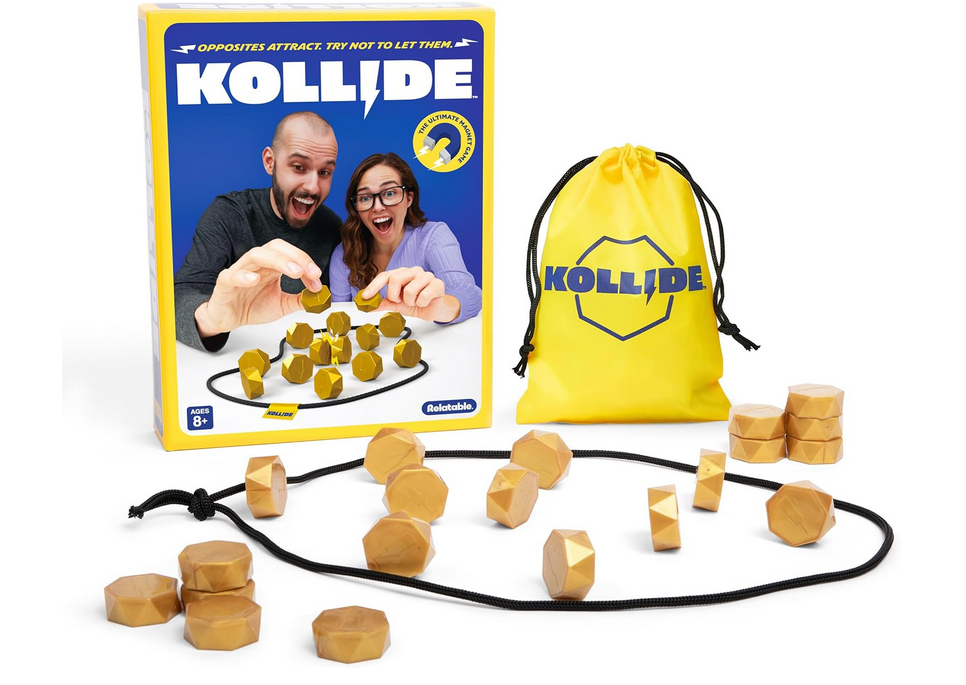
Kollide By Relatable, Exciting Magnetic Game for Family Game Night, Great Fun Games for Kids, Includes 1 Rope, 20 Magnets, and Instructions
Kollide Game Complete Review and Guide: The Magnetic Strategy Game Redefining Family Game Night
There is a particular kind of family game that earns a permanent place in the collection — not because it’s complicated, not because it comes in an impressive box, and not because it won an industry award. It earns its place because every single time someone suggests playing it, the answer is yes. The Kollide Game by Relatable is exactly that kind of game. Simple enough to explain in sixty seconds. Deep enough to keep experienced players genuinely engaged. Portable enough to go everywhere. Tense enough to produce real drama and real laughter in equal measure.
This comprehensive guide covers everything you need to know about the Kollide Game — what it is, how it plays, who it’s for, how it compares to other family games, and why it has captured the attention of millions of players across TikTok and beyond. Whether you’re considering the Kollide Game as a purchase for your own household, as a gift, or simply want to understand what all the conversation is about, this is the complete resource.
What Is the Kollide Game?
The Kollide Game is a magnetic strategy game designed and produced by Relatable, a brand focused on accessible, high-fun-per-dollar games for families and groups. At its core, the Kollide Game challenges players to place magnets along a rope without allowing those magnets to attract and snap together. As more magnets enter play, the tension — physical and psychological — builds with every turn. The game ends dramatically when magnets collide, which gives the Kollide Game both its name and its defining gameplay moment.
The Kollide Game box contains everything needed to play immediately upon opening: one rope, twenty magnets, a carrying bag, and an instruction sheet. There is nothing to assemble, no batteries required, no digital components, and no prerequisite game knowledge necessary. The Kollide Game is rated for ages eight and up by its manufacturer, though player experience confirms that children as young as five can participate successfully with minor rule modifications and light adult guidance.
The recommended player count for the Kollide Game spans two through as many as can reasonably gather around the rope, making it one of the more scalable social games in its category. This scalability is a genuine practical advantage — unlike many strategy games that only function at specific player counts, the Kollide Game works whether you’re playing a two-player head-to-head match or a chaotic eight-person party game round.
The Mechanics Behind the Kollide Game: Simple Rules, Real Depth
Understanding what makes the Kollide Game tick requires spending a moment on its central mechanic — and why that mechanic is more strategically interesting than its simple description suggests.
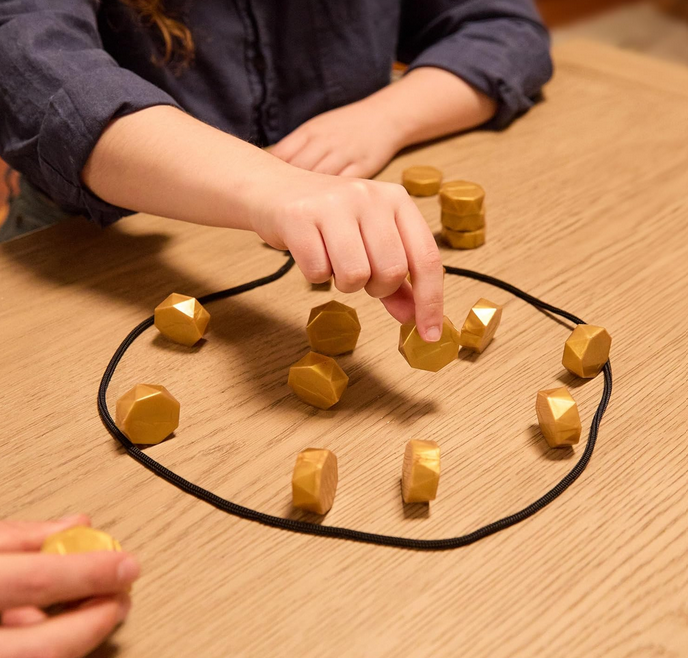
The magnets used in the Kollide Game are not decorative. They are functional, strong neodymium-style magnets that exert genuine attractive force on one another at close range. Players take turns placing magnets along the rope, and the physical properties of the magnets create a dynamic playing environment that changes with every piece placed. Early in the game, magnets can be positioned with relative confidence. As the Kollide Game progresses and more magnets occupy the rope, the margin for error shrinks dramatically — a placement that would have been safe in round three becomes dangerously close to triggering a collision in round twelve.
This scaling tension is the design genius at the center of the Kollide Game. The game gets more difficult as it progresses not because the rules change but because the physical environment changes. Players must read the magnetic field created by existing pieces, anticipate how a new placement will interact with neighbors, and balance the competitive desire to make progress against the strategic imperative of not triggering the collapse that ends the round. The Kollide Game is simultaneously a game of spatial awareness, risk assessment, and nerve management — qualities that most games achieve only through complex rule systems, but which the Kollide Game delivers through pure physical mechanics.
The result is a game that is genuinely easy to learn — the rules take less than two minutes to explain — but contains enough strategic depth to reward experienced play. Veteran Kollide Game players develop real skills: understanding which rope positions are safer for placement, recognizing when an opponent is being forced toward a dangerous move, and calibrating the risk level of each turn against the current state of the board. That learning curve, invisible to beginners but real to those who play regularly, is part of what makes the Kollide Game a true long-term keeper rather than a novelty that loses its appeal after a handful of sessions.
Who Is the Kollide Game For?
One of the most impressive qualities of the Kollide Game is the breadth of player profiles it serves well. This is not a game that works for a specific type of person — it genuinely works for almost everyone, which is a rare quality in any game category.
Families with Mixed Age Groups
The Kollide Game shines brightest in the mixed-age family context because its physical mechanics naturally provide a degree of age-leveling that rule-based handicaps can’t replicate. An eight-year-old and a forty-year-old are both subject to the same magnetic physics, the same building tension, and the same split-second judgment calls. The experienced adult doesn’t have an inherent cognitive advantage that overwhelms a child’s developing strategic thinking — the Kollide Game keeps the field genuinely competitive across age groups.
Parents of children aged five through twelve report the Kollide Game as one of their most-used family games precisely because it doesn’t require constant parental adjustment to remain balanced. Kids feel the genuine thrill of winning because their wins are real — earned through skill and focus rather than gifted by an adult playing below their level.
Game Night Groups
For adults hosting regular game nights, the Kollide Game fills the valuable role of the quick-play opener or palette cleanser between heavier titles. Its short round length — typically five to fifteen minutes depending on player count and skill level — means it can be completed in the time it takes others to arrive, or slotted between longer games to maintain energy and engagement. The Kollide Game‘s social dynamics also work particularly well in adult groups: the tension builds in ways that produce genuine reactions, the collapse moments are communal experiences that generate real laughter, and the competitive investment that players develop quickly creates the kind of friendly rivalry that makes game nights memorable.
Travelers and Outdoor Enthusiasts
Few family games offer genuine travel practicality. Most board games are too bulky, too fragile, or too dependent on flat surfaces and specific environmental conditions to function well outside the home. The Kollide Game is an exception. The carrying bag keeps all twenty magnets and the rope contained in a package smaller than most board game instruction booklets. The Kollide Game has been played successfully on camping trips, beach vacations, road trip rest stops, train journeys, hotel rooms, and backyard gatherings — anywhere that players can gather around the rope and compete.
The absence of electronic components or fragile printed materials means the Kollide Game is genuinely weatherproof in practical terms. Magnets don’t care about humidity or temperature variations. The rope doesn’t require careful storage. The Kollide Game is simply ready to play wherever you bring it — a quality that earns it a permanent spot in travel bags and camping kits for families who take it along once.
Gift Buyers
The Kollide Game solves one of the most persistent gift-buying problems in the games category: finding something appropriate for a recipient whose exact gaming preferences you don’t know. The Kollide Game works as a gift for children aged eight and up, teenagers of both genders, adults of any gaming background, and families of any composition — making it one of the most confidently giftable games available. Its price point falls comfortably in the gift category that feels genuinely thoughtful without requiring significant expenditure, and its TikTok-fueled cultural recognition means that many recipients will already have seen the Kollide Game in action and be excited to receive it.
The Kollide Game and the Chess Connection: Strategy Development for Kids
The Kollide Game carries an interesting marketing note worth exploring in depth: it is described as a tool for building chess knowledge and strategic thinking skills. At first, connecting a magnetic rope game to chess might seem like a stretch. In practice, the connection is more meaningful than it appears.
Chess education for children is built around a small set of foundational cognitive skills: spatial awareness, consequence anticipation, risk calibration, and the ability to evaluate a position accurately under competitive pressure. The Kollide Game develops all four of these skills in a more accessible, more immediately engaging format than chess itself.
Spatial awareness is demanded by every Kollide Game turn. Players must assess the three-dimensional environment created by existing magnets on the rope, understand how magnetic attraction operates across distances, and identify placement positions that minimize collision risk. This is a form of spatial reasoning that translates directly to chess piece positioning and board evaluation.
Consequence anticipation — understanding that a move made now will create a situation that affects future options — is the central strategic challenge of both chess and the Kollide Game. A magnet placed carelessly in the Kollide Game creates a dangerous cluster that forces subsequent players into increasingly risky positions. The player who can see two or three moves ahead in the Kollide Game, identifying how their placement will constrain their opponent’s options, is exercising exactly the forward-thinking cognitive muscle that chess instruction is designed to build.
Risk calibration in the Kollide Game asks players to make probabilistic judgments under pressure — assessments of how close a placement is to triggering a collision, weighted against the strategic value of that position. This kind of judgment under uncertainty is precisely what differentiates strong chess players from weak ones, and the Kollide Game trains it in a low-stakes, high-engagement context that children find genuinely motivating.
For parents interested in developing their children’s strategic thinking without the learning curve that chess imposes on younger players, the Kollide Game represents a genuinely effective preparatory experience — one that builds the relevant cognitive skills through play rather than instruction.
Kollide Game vs. Other Family Strategy Games: How It Compares
The family strategy game category is crowded, and understanding how the Kollide Game positions itself relative to established alternatives helps buyers make confident decisions.
Kollide Game vs. Jenga
The comparison to Jenga is the most natural one — both games involve physical manipulation of objects under increasing tension, with a dramatic failure state that ends the round. But the Kollide Game differs from Jenga in several important ways. The magnetic mechanics of the Kollide Game create an invisible force field around every piece, meaning the game’s complexity grows not just from the physical structure but from the electromagnetic environment. Jenga’s tower is a static object that players remove pieces from; the Kollide Game‘s rope is a dynamic environment that players add to, changing the magnetic landscape with every turn. The Kollide Game also packs down significantly smaller than any Jenga set, giving it a clear portability advantage.
Kollide Game vs. Connect Four
Connect Four is a pure abstract strategy game with no physical tension component. The Kollide Game shares Connect Four’s accessibility — both can be taught in minutes and played by children from age six upward — but introduces the physical, tactile, and sensory dimension that makes its gameplay moments viscerally memorable. The Kollide Game also scales to larger player counts more naturally than Connect Four’s strict two-player format.
Kollide Game vs. Card Games
Popular family card games like Uno or Skip-Bo require a flat, stable surface, dealer rotation, and sufficient familiarity with card management for younger players to engage fully. The Kollide Game requires none of these conditions — it plays on any surface, needs no designated dealer, and its physical mechanics are universally intuitive regardless of age or prior game experience. For families who want something faster to set up and easier to play in informal settings, the Kollide Game consistently outperforms card games in practical terms.

The TikTok Effect: Why the Kollide Game Went Viral
Social media virality in the board game space is not automatic, and it’s worth understanding why the Kollide Game specifically caught on rather than simply noting that it did.
The Kollide Game has three qualities that make it extraordinarily well-suited to short-form video content. First, the gameplay is visually telegraphed — a viewer watching a Kollide Game clip for the first time understands the objective and the tension within seconds, without any narration required. Second, the collision moment — when magnets snap together and the round ends — is a perfectly contained dramatic beat that lands with immediate emotional impact in video form. Third, the player reactions are genuine and varied: the slow-motion concentration during a careful placement, the barely-contained panic as magnets inch closer together, the explosive reaction when the inevitable collision happens — all of these make for compelling content that different creators can film differently and still produce engaging videos.
The TikTok presence of the Kollide Game has driven discovery among audiences who might never have encountered it through traditional toy retail channels — teenagers who became interested after seeing it in their For You Page, young adults who recognized it from a gaming content creator, and parents who saw the genuine family fun captured in user videos and immediately understood the purchase appeal. This organic discovery loop is one of the reasons the Kollide Game has built the kind of sustained commercial momentum that paid advertising rarely produces.
Kollide Game: What’s in the Box and How It All Works Together
Understanding the physical components of the Kollide Game helps buyers set accurate expectations and appreciate the design thinking behind each element.
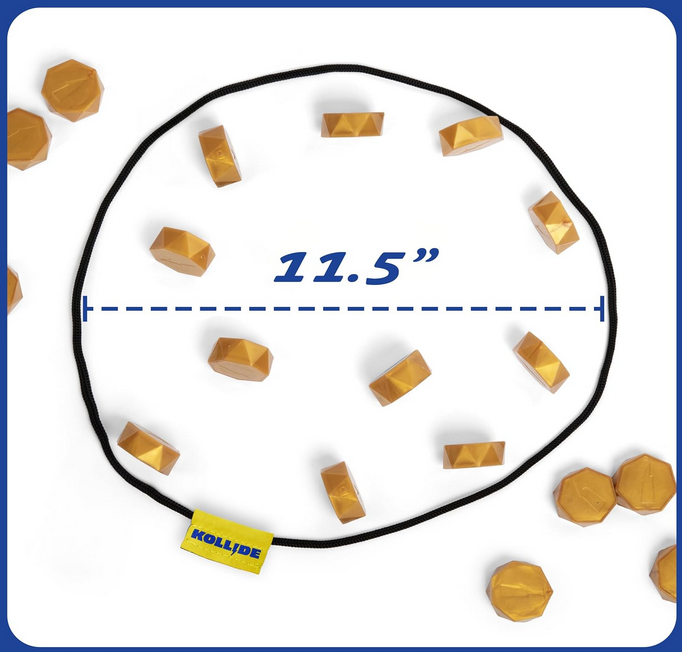
The Rope is the playing field of the Kollide Game — the surface along which magnets are placed and the structure around which the entire game is organized. The rope’s flexibility is a deliberate design choice: unlike a rigid rod or track, the rope can be configured in different shapes depending on player preference and available space, adding a subtle environmental variable to the Kollide Game experience. Players who want a more chaotic arrangement can coil or curve the rope differently; those who prefer a more linear game can stretch it straight.
The Twenty Magnets are the primary game components and the source of all the Kollide Game‘s drama. Each magnet is sized to be comfortable to handle for players aged eight and up — large enough to grasp deliberately, small enough to require genuine dexterity in careful placement. The magnetic strength is calibrated to create meaningful tension at close range without being so powerful that careful play becomes impossible: strong enough to snap dramatically when triggered, controllable enough to allow skilled players to place pieces with precision.
The Carrying Bag is a quality-of-life detail that experienced game buyers will immediately appreciate. Loose small components — exactly what twenty magnets represent — are the primary cause of incomplete game sets over time. The dedicated bag keeps every magnet accounted for, makes the Kollide Game genuinely portable, and contributes to the game’s longevity in active households where games get played frequently and stored casually.
The Instructions are appropriately brief — the Kollide Game doesn’t require a rulebook. The instruction sheet covers the core objective, turn structure, and win conditions clearly enough for any literate player to understand independently, which means no one needs to be the designated rules explainer at the table.
Parent Guide: Getting the Most from the Kollide Game at Every Age
For families purchasing the Kollide Game for children, a few practical considerations maximize the experience across different age groups.
For ages 5–7 (below the official age recommendation): The Kollide Game can be enjoyed by children younger than eight with adult supervision, primarily to prevent fingers from being caught in strong magnetic snaps. At this age, the game works best in a cooperative or low-stakes format where the goal is shared discovery of the magnets’ behavior rather than competitive play. Children in this range often enjoy the sensory experience of the magnets themselves as much as the game structure.
For ages 8–10: This is the prime demographic for the Kollide Game as designed. Children in this range are old enough to understand and apply the rules independently, competitive enough to be genuinely invested in winning, and young enough that the physical tension of the game feels excitingly novel. The Kollide Game at this age often becomes the game kids request daily for extended periods.
For ages 11–14: Tweens and early teenagers engage with the Kollide Game at a more strategic level, developing genuine placement tactics and reading the competitive dynamics of the rope environment more sophisticatedly. At this age, the Kollide Game works well in both family and peer group contexts — it’s one of the few games that doesn’t feel childish in a teen social setting while still being appropriate for the family table.
For adults: The Kollide Game among adults produces the full competitive experience the game is designed for. Adult players develop the most sophisticated placement strategies, read each other’s intentions most accurately, and invest most deeply in the competitive dynamics of each round. The Kollide Game consistently earns repeat play among adult groups because the skill ceiling is higher than the simple premise suggests.
Where to Use the Kollide Game: Every Context Where It Excels
The versatility of the Kollide Game across different settings is one of its most compelling selling points. Here is a practical breakdown of the contexts where the Kollide Game performs best.
Family Game Night: The core use case and the environment the Kollide Game was designed for. Short enough to fit multiple rounds into an evening, engaging enough to satisfy players of all ages, and dramatic enough to produce the shared moments that make game night memories.
Camping and Outdoor Play: The carrying bag and component durability make the Kollide Game ideal for outdoor settings. No power source, no fragile components, no setup requirements — the Kollide Game is ready to play around a campfire, at a picnic table, or in a tent on a rainy afternoon.
Road Trips: With the magnets secured in their bag and the rope coiled small, the Kollide Game travels in a jacket pocket. Rest stop games, hotel room entertainment, and back-seat play (for passengers, not drivers) are all natural uses for the Kollide Game in transit.
Holiday Gatherings: The Kollide Game is one of the rare games that can be played by a group of relatives ranging from eight to eighty without anyone feeling excluded or condescended to. The physical nature of the mechanics transcends the generational gap that catches out many games in family gathering contexts.
Party Games: The Kollide Game scales to party contexts through tournament-style elimination rounds, where multiple two-player matches determine a final champion. This format extends the Kollide Game across an entire party event while keeping individual rounds short enough to maintain energy.
Classroom and Educational Settings: The strategic thinking, turn-taking, and problem-solving elements of the Kollide Game make it a natural fit for educational contexts where game-based learning is used to develop cognitive skills. Teachers report the Kollide Game as one of the more effective classroom games for developing spatial reasoning and cooperative social skills simultaneously.
Final Verdict: Is the Kollide Game Worth It?
The Kollide Game earns an unqualified recommendation for an unusually broad range of buyers. It delivers genuine strategic depth through elegantly simple physical mechanics. It works across a wider range of ages and player counts than almost any comparable game in its price tier. It is genuinely portable in a way that most family games are not. It produces authentic, repeatable fun that doesn’t require novelty to sustain — experienced players return to the Kollide Game because the skill-based competition rewards returning, not merely because it’s new.
For families building a game collection, the Kollide Game fills the rare role of the game that actually gets played — the one that comes off the shelf on Tuesday evenings, gets requested before dinner, and travels in the bag to grandma’s house. Those games are more valuable than games with elaborate components and impressive price tags that come out twice a year for special occasions.
For gift buyers, the Kollide Game is among the most confidently giftable items in the family game category: appropriate for a wide age range, priced sensibly, recognizable from social media exposure, and genuinely exciting to receive. Whether you’re shopping for a birthday, a holiday stocking, a classroom prize, or a host gift for a family you know loves game nights, the Kollide Game delivers on every practical gifting criterion.
For anyone who has seen the Kollide Game in action on TikTok and wondered whether the experience lives up to the videos — it does. The tension, the drama, the laughter, and the absolute chaos of a perfect magnetic collision are all real, repeatable, and every bit as enjoyable at your own table as they look in a thirty-second clip. The Kollide Game is the rare viral product that earns its reputation through genuine merit rather than marketing momentum.
Buy it. Play it. Prepare to say “just one more round” more times than you planned.
The Art of the Perfect Game Night: What Magnetic Strategy Teaches Us About Play
There is something almost philosophical about the moment a magnet slips just a fraction of an inch too far and the inevitable happens. The snap. The collapse. The eruption of laughter, groaning, and dramatic table-pounding that follows. In that single instant, everyone around the rope is completely present — not thinking about work, not checking their phone, not half-watching something on a screen in the background. Just fully, completely alive to the moment unfolding in front of them.
This is what the best games do. Not the most expensive ones, not the most complicated ones, not the ones with the most elaborate components or the deepest lore. The best games create presence. They pull people out of their individual mental orbits and into a shared space where something genuinely unpredictable is happening and everyone cares about the outcome.
Understanding why this particular magnetic rope game achieves that effect so consistently — and what it reveals about the broader nature of great game design — is worth exploring in depth.
The Psychology of Tension-and-Release in Game Design
Game designers have known for decades that the most emotionally engaging games are built around a cycle of tension and release. The tension builds through accumulation — of stakes, of complexity, of risk — and releases in a moment of resolution that feels both inevitable in retrospect and genuinely surprising in the instant it occurs.
Chess builds this tension through positional pressure over dozens of moves. Poker builds it through betting rounds and hidden information. Jenga builds it through the physical instability of a tower growing more precarious with every removed block.
What makes the magnetic rope format so psychologically effective is the speed and clarity of its tension curve. Unlike chess, where the decisive moment may be invisible to casual observers, or poker, where the drama requires understanding hand rankings and betting strategy, the tension in this style of play is physically visible and universally legible. Every person in the room — whether they’re playing or watching — can see the magnets getting closer. Everyone understands instinctively what happens if they touch. The tension is not hidden inside strategic complexity. It is right there on the rope, building in real time, readable by a five-year-old and a chess grandmaster with equal immediacy.
This universal legibility is what makes the game so effective as a social object. It doesn’t require the audience to understand the game to feel the tension. The room participates emotionally regardless of whether everyone is playing — which is why the best moments around the rope tend to involve the whole room holding its breath, not just the active players.
What Magnetic Games Reveal About Risk and Decision-Making
Every placement during a round of magnetic rope play is a miniature risk assessment. The player holding a magnet above the rope is performing, in simplified form, the same cognitive operation that underlies every meaningful decision under uncertainty: evaluating the probability of a bad outcome, weighing it against the benefit of the action, and making a call with incomplete information about what will happen next.
This is not a trivial cognitive exercise dressed up in game form. It is genuinely the same mental structure as financial risk assessment, medical decision-making, sports strategy, and negotiation. The difference is that in the game context, the stakes are low enough to allow full cognitive engagement without the anxiety that real-world high-stakes decisions produce — which is precisely what makes it an effective training environment for the underlying skill.
Psychologists who study decision-making under uncertainty have long argued that the best way to develop calibrated risk assessment is through repeated low-stakes practice in environments where outcomes are immediate and unambiguous. Most real-world decisions don’t provide that feedback loop — you make a choice, and the consequences unfold over weeks, months, or years in ways that are difficult to connect causally to the original decision.
A game built on magnetic tension provides exactly the feedback loop that real-world risk assessment rarely does. You make a placement decision. Within seconds, you know whether it was right. The consequences are immediate, unambiguous, and directly attributable to your specific choice. Over repeated play sessions, this feedback loop builds genuine calibration — an intuitive sense of how close is too close, how much risk is acceptable at different stages of the game, and when the bold move is worth the danger.
Parents who notice their children becoming more thoughtful, patient decision-makers after extended engagement with tension-based games are observing a real cognitive effect, not wishful thinking.
The Social Architecture of a Great Game
Beyond the cognitive dimensions, magnetic strategy games like this one are social architecture — structures that organize how people relate to one another during the time they spend playing.
Consider what the game does to a room of people who might otherwise struggle to connect. The grandparent who doesn’t understand their teenage grandchild’s interests. The coworkers who are friendly but don’t have much to talk about outside work. The siblings who have been arguing all day. The new partner meeting the family for the first time.
The rope and magnets give all of these people a shared focal point, a common language of tension and release, and a set of interactions — turns taken, encouragements offered, catastrophes shared — that build rapport organically without requiring anyone to perform connection. The game creates the conditions; the people fill them.
This is why the most beloved family games are not necessarily the most intellectually stimulating or the most beautifully produced. They are the ones that create the most reliably good conditions for genuine human connection. The game that gets played on holidays for thirty years is not the game with the best mechanics. It is the game that reliably makes the room feel good — that produces laughter, rivalry, shared history, and the kind of small moments that accumulate into something that feels, in retrospect, like the fabric of family life.
A magnetic rope game earns its permanent place in family collections not because it is the most sophisticated game ever designed, but because it reliably produces exactly those conditions. Every session adds another story to the shared collection. The time your youngest triggered a collapse on the very first placement. The evening your mother-in-law turned out to have nerves of steel while everyone else buckled under pressure. The camping trip where the wind kept interfering with careful placements and turned a strategy game into pure chaos. These stories accumulate around games that get played repeatedly, and they are the real product that great games deliver.
The Portability Principle: Why the Best Games Go Everywhere
There is a meaningful difference between games that are played and games that are available to be played. The distinction sounds trivial but has enormous practical consequences for which games actually become part of a family’s life and which become shelf decoration.
A game that requires a dedicated table, specific lighting conditions, a full complement of players, and thirty minutes of setup and teardown is available to be played under specific circumstances that must be deliberately arranged. A game that lives in a small bag, sets up in thirty seconds, and works with two players on a campsite picnic table or a hotel room floor is available to be played almost anywhere, almost anytime, with almost anyone.
The gap between those two availability profiles determines, over the long run, how much actual play a game generates. The most elaborately produced game in the collection — the one with the beautiful box, the custom meeples, the thick card stock — often generates fewer total hours of genuine play than the simple game in the carrying bag that gets grabbed on the way out the door.
This is the portability principle applied to game design: the games that travel are the games that get played. And the games that get played are the ones that actually deliver the value — the connection, the laughter, the shared moments — that all games theoretically promise but only frequently-played ones actually provide.
Magnetic rope games exemplify this principle better than almost any other format. Twenty magnets and a rope in a small bag represent a complete, fully functional gaming experience that fits in a coat pocket. The carrying bag is not a convenience feature — it is an enabler of the game’s entire value proposition. Without it, the game lives on the shelf. With it, the game goes everywhere and gets played constantly.
Strategy Deep Dive: How Experienced Players Think Differently
Casual players and experienced players approach the magnetic rope format with noticeably different mental frameworks, and understanding those differences illuminates the game’s genuine strategic depth.
The Casual Player’s Approach
A player encountering this type of game for the first time typically focuses on the immediately visible: which positions on the rope look obviously dangerous (too close to existing magnets) and which look obviously safe (far from any existing pieces). This is a reasonable starting point and produces functional early-game play. The casual player’s primary concern is avoiding an immediately obvious mistake.
The limitation of this approach becomes apparent in the mid-to-late game, when the rope is sufficiently populated with magnets that no position is obviously safe. At this point, the casual player is essentially guessing — selecting positions that look less dangerous rather than positions that are strategically optimal — and their outcomes are largely determined by luck rather than skill.
The Experienced Player’s Approach
An experienced player thinks about the rope not as a collection of individual positions but as a dynamic magnetic field with zones of varying risk. They develop an intuitive model of how the existing magnets’ combined attraction affects every potential placement position — not just the obvious neighbors, but the more distant pieces whose pull contributes to the field in less visible ways.
More importantly, the experienced player thinks about future states rather than current states. The question they’re asking is not “is this position safe right now?” but “what does placing here do to the positions available to my opponent in the next two turns?” This forward projection — placing a magnet not in the safest current position but in the position that creates the most difficulty for subsequent players — is the hallmark of genuinely strategic play.
The experienced player also manages their own psychology under pressure. The late game is as much a test of nerve as a test of spatial reasoning — the physical sensation of holding a magnet over a densely populated rope while competitors watch creates genuine psychological pressure that affects decision quality. Players who have developed the ability to maintain deliberate, analytical thinking under that pressure consistently outperform equally intelligent players who haven’t.
The Learning Curve as a Feature
The gap between casual and experienced play in a well-designed tension game is itself a feature rather than a bug. Games where skill development makes no difference — where every session is essentially random — lose their appeal quickly because there is no progress narrative for the player to inhabit. Games where the skill ceiling is so high that beginners cannot compete at all lose their social utility because they cannot be played across different experience levels.
The magnetic rope format hits an ideal middle point: beginners can participate meaningfully and win rounds through a combination of reasonable decision-making and favorable variance, while experienced players have genuine skills to develop that improve their outcomes over time. This balance is what makes the format work across a thirty-year age range at the same table — everyone is competitive, everyone is developing, and no one is simply waiting for the inevitable outcome of skill differentials that are too large to overcome.
Magnetic Games in the Broader Context of the Modern Games Renaissance
The explosive growth of the tabletop and physical games market over the past decade represents one of the more interesting cultural countertrends of the digital age. At a moment when almost every form of entertainment has migrated toward screens and on-demand digital delivery, physical games are growing faster than almost any other entertainment category.
The reasons are worth examining, because they illuminate why a magnetic rope game — an analog, screen-free, physically simple object — finds such a ready audience in 2026.
The screen saturation effect is real and increasingly well-documented. Households where every member has a personal device, where the television runs continuously, and where work and leisure have blended into a single screen-mediated existence are actively seeking activities that offer genuine presence and screen-free engagement. Physical games provide this in a way that is socially acceptable, age-inclusive, and genuinely entertaining rather than merely virtuous.
The social reconnection impulse has intensified significantly in the post-pandemic period. People who experienced the social impoverishment of extended isolation have developed a keener appreciation for face-to-face engagement and the specific quality of attention that shared physical activities produce. Games that bring people into the same room, around the same object, paying attention to the same thing, are filling a need that no digital substitute can replicate.
The gift economy around physical games has also grown substantially. As the challenges of gifting in the digital age have intensified — streaming subscriptions are increasingly universal, digital games are often already owned, and personalized gifts require research and attention that time-pressed gift buyers struggle to provide — physical games have emerged as a reliable category that photographs well, feels substantial, and delivers clearly communicable value. A game in a box is a legible gift in a way that a streaming credit or digital download is not.
The magnetic rope format benefits from all three of these tailwinds simultaneously. It is emphatically screen-free. It creates genuine in-person presence and shared attention. And it makes an excellent gift across a wide range of recipients and occasions. Its success is not despite the digital age — it is, in part, a product of what the digital age has made people hungry for.
Building a Collection Around a Magnetic Strategy Game
For households that have discovered the appeal of tension-based physical games, the natural next question is what else belongs in the collection. The magnetic rope format pairs particularly well with several other game categories that share its best qualities: fast setup, short rounds, broad age appeal, and genuine replayability.
Cooperative board games complement the competitive tension of magnetic play by providing a collaborative counterpoint — games where the table works together against the game system rather than against each other. After several intense competitive rounds of magnetic play, a cooperative game resets the social dynamic and builds a different kind of shared experience. Gateway cooperative titles like Pandemic, Forbidden Island, or The Crew are natural pairings.
Dexterity games occupy the same physical, tactile space as magnetic play and appeal to the same instinct for hands-on, embodied gaming. Rhino Hero, Beasts of Balance, and Suspend all offer the physical tension and dramatic failure moments that define the magnetic format, with different mechanical approaches that keep the broader collection feeling varied.
Quick card games provide the fastest possible game sessions for moments when even a short setup is too much — commutes, waiting rooms, or the last fifteen minutes before bedtime. Games like Exploding Kittens, Sushi Go, and No Thanks share the magnetic format’s accessibility and short session length in a different physical form.
Strategy games with simple rules and deep play serve the household members who want to develop the kind of forward-thinking skills that tension-based games introduce. Azul, Ticket to Ride, and Carcassonne all offer genuinely strategic play in accessible formats that work across age groups — natural extensions of the strategic thinking that magnetic rope games begin to develop.
The Lasting Appeal: Why Simple Games Endure
The history of games is filled with examples of simple mechanical concepts that have endured for decades or centuries while elaborate, expensive, sophisticated alternatives have come and gone. Chess has survived a thousand years in essentially unchanged form. Checkers predates the printing press. Dominoes have been played continuously across cultures and centuries.
What these enduring games share is not complexity or production value — it is mechanical elegance. A game mechanic is elegant when a simple rule set generates disproportionate variety in how sessions play out, when the learning curve is gentle enough to allow broad participation but the skill ceiling is high enough to reward continued engagement, and when the physical or conceptual object at the game’s center is inherently satisfying to interact with.
Magnetic attraction is an inherently satisfying physical phenomenon. The pull between pieces, the building tension as they approach, the dramatic snap of contact — these are sensory experiences with a deep appeal that transcends cultural context, age group, and prior gaming experience. A game built around this phenomenon inherits that appeal at no additional design cost.
The most enduring games in any household collection will be the ones that feel as natural to play on the hundredth session as they did on the first — not because they haven’t been figured out, but because their core experience is rooted in something that remains satisfying regardless of familiarity. The feel of a perfectly placed magnet. The held breath of a near-miss. The explosive release of an inevitable collision.
These are not experiences that get old. They are experiences that, played repeatedly across years and seasons and family configurations that change as children grow and relatives visit and friends come and go, become something richer than entertainment. They become shared history. The record of time spent together, present and laughing, around a rope and twenty magnets.
That is what the best games deliver. And that is why the simplest ones so often last the longest.
Discover More Games, More Brands, and More Play at Game for Gamers
The Kollide Game is one of the most compelling recent additions to the family game category — but it exists within a much larger world of games, brands, and play experiences worth knowing. Whether you discovered this magnetic strategy game through TikTok, received it as a gift, or are researching it as a potential purchase, your interest in finding games that genuinely deliver on their promise is exactly what drives everything we cover.
Game for Gamers is the complete resource for players of every kind — covering video games across PlayStation, Xbox, Nintendo Switch, and PC; tabletop and board games from Hasbro Gaming, Games Workshop, and beyond; collectible card games including Pokémon and Magic: The Gathering; educational toys and games for young children from Fisher-Price, LeapFrog, and Melissa & Doug; gaming hardware and peripherals from Logitech G, Razer, SteelSeries, and more; and the full spectrum of outdoor, party, and travel games that complete a well-rounded family collection.
At Game for Gamers, every recommendation is built around the actual experience of the person who is going to play — not around what’s easiest to promote or most profitable to feature. That means honest age-by-age guidance, realistic assessments of replay value and strategic depth, and gift recommendations organized around what we know about the recipient rather than what happens to be trending. Whether you’re building your first game collection, looking for the right gift for a specific person, or trying to find the next great addition to an established household library, Game for Gamers is where that search belongs.
Explore brand guides, age-group recommendations, platform breakdowns, and in-depth game reviews — all in one place, all written for the player rather than the retailer.
What exactly is the Kollide Game and how do you play it?
The Kollide Game is a magnetic strategy game made by Relatable in which players take turns placing magnets along a rope without letting any of the magnets snap together. Each player must carefully position their magnet on the rope while accounting for the magnetic pull of every piece already in play. The round ends the moment two or more magnets collide — and the player who caused the collision loses that round. The Kollide Game is built around this simple but genuinely tense mechanic, which creates escalating drama with every turn as more magnets enter the field and the safe placement options narrow.
What age is the Kollide Game appropriate for?
The Kollide Game is officially recommended for ages eight and up. At this age, children have the dexterity, focus, and rule comprehension to engage with the game fully and independently. That said, many families successfully include younger children aged five through seven with light adult supervision — primarily to ensure small fingers stay clear of strong magnetic snaps during play. On the upper end, the Kollide Game has no age ceiling. Teenagers and adults engage with it at a more competitive and strategic level, and it is equally popular among adult game night groups as it is among families with young children.
How many players can play the Kollide Game at once?
The Kollide Game works well with two players in a focused head-to-head format, and scales effectively to larger groups for party-style play. Because each turn is quick and the round ends with a single dramatic event, larger groups can play elimination-style tournaments where multiple players compete in sequence. Most households find the Kollide Game works best with two to six players, though its flexible format means there is no strict upper limit for casual play.
How long does a typical round of the Kollide Game take?
A standard round of the Kollide Game typically runs between five and fifteen minutes, depending on the number of players and the experience level at the table. Beginners tend to play faster because they take more risks; experienced players who have developed careful placement strategies may extend rounds longer as both sides work to avoid being the one who triggers the collision. The short round length is one of the Kollide Game’s most practical qualities — it makes the game easy to fit into any schedule and naturally encourages the “just one more round” dynamic that players consistently describe.
Is the Kollide Game safe for young children?
The Kollide Game is designed for ages eight and up, and that recommendation exists primarily because of the strength of the magnets included. The magnets in the Kollide Game are strong enough to snap together with meaningful force, which is central to the game’s dramatic appeal but means small fingers can get caught if a collapse happens quickly. For children under eight who want to participate, adult supervision is recommended and the game remains enjoyable with that precaution in place. The magnets should also be kept away from infants and toddlers, as with all small strong magnets. Beyond the age-appropriate supervision consideration, the Kollide Game is a safe, non-toxic, battery-free game with no sharp edges or fragile components.
Can the Kollide Game be played outdoors?
Yes — the Kollide Game is one of the better family games for outdoor play. The included carrying bag keeps all twenty magnets and the rope contained and portable, and the game requires no flat surface, no power source, and no fragile printed components. The Kollide Game has been played successfully at campsites, on beach trips, at backyard barbecues, during road trip rest stops, and at picnic tables. The only environmental consideration worth noting is wind — in breezy outdoor conditions, the rope can shift during careful placement moments, which some players find adds an extra chaotic element and others find frustrating. In calm outdoor conditions, the Kollide Game performs exactly as it does indoors.
Customer Reviews
We bought the Kollide Game on a whim during a family game night restock, and it has genuinely become the most-requested game in our house. Our kids are five and nine, and I was slightly worried the age gap would make it awkward — it didn’t. Both of them picked up the rules in under five minutes, and by the second round they were playing with real strategy and genuine competitive focus. What surprised me most was how engaged my older child stayed even when playing against a much younger sibling. The magnetic mechanic naturally levels the playing field in a way that feels fair to everyone at the table. The pieces feel solid and well-made, which matters a lot when you have kids who are not exactly gentle with their toys. We’ve played this more times than I can count in the past month and nobody has gotten bored yet. Highly recommend for any family looking for a simple game that actually gets played.
Packed the Kollide Game in my backpack for a weekend camping trip with four adults and three kids ranging from seven to fourteen. I honestly expected it to be a quick novelty that got put away after one round. Instead we played for two hours straight on the first night and broke it out again every evening after that. The carrying bag is genuinely useful — everything stays together and the whole game takes up less space than a paperback book. What I love most is how fast it plays. You can finish a full round in ten minutes, which means you can fit in three or four games before anyone’s patience runs out. The competitive tension is real, too — grown adults were getting dramatically invested in not being the one who let the magnets snap. Fast, portable, fun for all ages, and the kind of thing you reach for when you want to play something without spending ten minutes explaining rules. Great purchase.
I’ll be honest — when the Kollide Game arrived I looked at the box and thought “this is it?” A rope and twenty magnets. Seemed underwhelming. Then we played it. Within two turns the entire table was completely locked in, arguing strategy, catastrophically losing focus at critical moments, and laughing uncontrollably when someone triggered a full magnetic chain collapse. The game has this quality where the tension builds slowly and then releases all at once in a completely chaotic moment — and somehow that chaos is both infuriating and hilarious at the same time. The strategy element is more real than the simple premise suggests: where you place each magnet relative to existing ones matters, and experienced players develop genuine tactics. One note for parents of very young children — the magnets are strong, which is great for gameplay but means you’ll want to supervise little ones closely so fingers don’t get caught in a snap. Overall though, this is a genuinely impressive game for the price. One of those rare purchases that exceeded expectations significantly.