
Hardware That Was Ahead of Its Time and Still Holds Up Today
When Nintendo designed the GameCube, they built it around a processor and graphics pipeline that prioritized raw performance in ways that many of its contemporaries couldn’t match. The GameCube’s processor generates between six and twelve million polygons per second — a specification that eliminated the mid-game slowdowns that plagued earlier consoles and kept gameplay fluid and responsive regardless of what was happening on screen. The external bandwidth of 3.2GB per second gave the GameCube genuinely fast data transfer rates that translated directly into faster load times, smoother frame rates, and a more immediate play experience. For a console that launched in 2001, these specifications remain impressive in context — and they explain why GameCube games still look and play so cleanly on modern televisions with the right cable setup. The Platinum finish, with its distinctive silver-grey color and compact cube form factor, looks clean and purposeful on any entertainment setup two decades after its original release.
A Game Library That Contains Some of the Greatest Titles Ever Made
The Nintendo GameCube Platinum Console is a gateway to one of the most celebrated software libraries in gaming history — a collection of titles that have never been surpassed in their categories and that remain deeply enjoyable decades after their original release. The GameCube era produced The Legend of Zelda: The Wind Waker and Twilight Princess, Super Mario Sunshine, Metroid Prime 1 and 2, Super Smash Bros. Melee, Pikmin 1 and 2, Luigi’s Mansion, F-Zero GX, Resident Evil 4, and Paper Mario: The Thousand-Year Door — a roster of titles that consistently appear on lists of the greatest games ever made across every gaming era. Many of these games have never been ported or remade in fully equivalent form, making the original GameCube hardware the only way to experience them exactly as intended. For collectors and retro gaming enthusiasts, the GameCube library is the primary reason to own the console — and it is a reason that has not diminished with time.
Everything You Need to Play Is Included Right Out of the Box
The Nintendo GameCube Platinum Console package includes every component needed to start playing immediately — no additional purchases required before the first game session. The bundle contains the Platinum GameCube console itself, a power cable, an AV cable for television connection, and a Nintendo Platinum controller — the iconic compact gamepad that GameCube fans consistently describe as one of the most comfortable and well-designed controllers Nintendo has ever produced. The controller’s distinctive button layout, with the large central A button, the smaller flanking B, X, and Y buttons, and the notched analog trigger system, was designed for the specific demands of the GameCube’s game library and remains immediately comfortable for both returning players and newcomers to the platform. Having the full complement of cables and a controller included eliminates the additional cost and sourcing effort that separate component purchases would require — a practical advantage that makes the complete bundle the most convenient entry point into GameCube gaming.
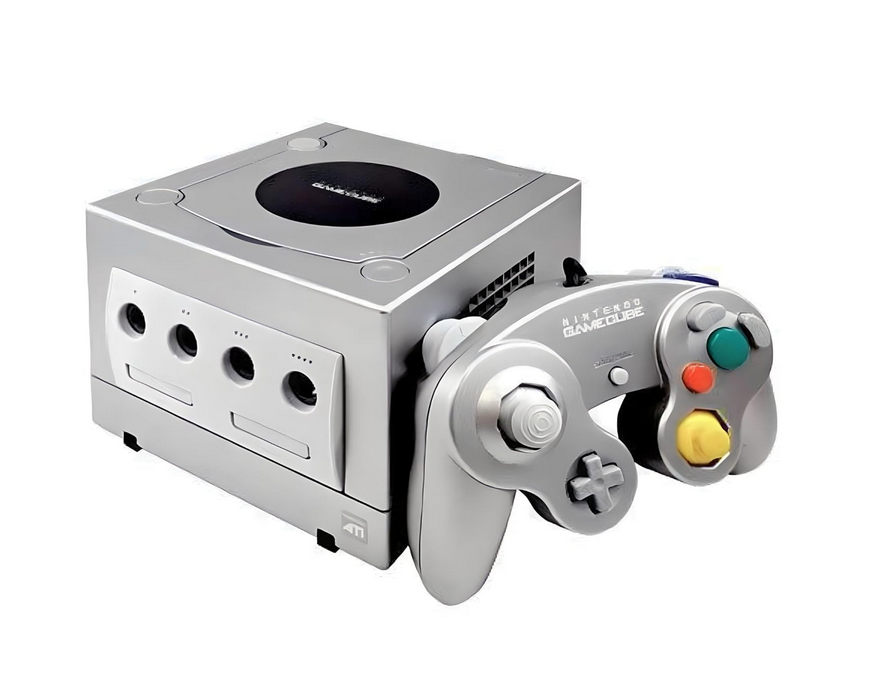
Gamecube Console Platinum
Nintendo GameCube Platinum: The Complete Collector’s Guide to Nintendo’s Most Underrated Console
There is a particular kind of nostalgia that attaches itself to the Nintendo GameCube — deeper and more specific than the general warm feeling most people carry for games they played in childhood. GameCube nostalgia is precise. It remembers the exact sound of the startup jingle, the distinctive click of the miniature disc loading, the weight of that unusual controller in the hand, the specific shade of purple or silver on a console that sat on the floor of a bedroom or living room through some of the most formative gaming years a generation ever experienced.
That specificity is not accidental. The GameCube was a genuinely unusual console — unusual in its hardware philosophy, unusual in its physical design, unusual in the games it produced and the experiences it created. It was commercially overshadowed during its lifespan by the PlayStation 2 and the original Xbox, and it was discontinued in 2007 after a run that many observers at the time considered disappointing. And yet, in the years since, the GameCube has undergone one of the most remarkable reputation rehabilitations in gaming history — rising from commercial underperformer to beloved collector’s cornerstone, from the console Nintendo fans made excuses for to the console they celebrate most passionately.
This guide examines the Nintendo GameCube Platinum console in full: its hardware design and technical specifications, its extraordinary game library, the collector’s market that has grown around it, the practical considerations for buyers in 2026, and the deeper cultural significance of a console that has come to mean something very specific to the generation that grew up playing it.
The GameCube in Context: Nintendo’s Risk and Its Legacy
Understanding the GameCube requires understanding the moment Nintendo was in when it designed the console. The Nintendo 64 era had established Nintendo’s dominance in the 3D platformer space — Super Mario 64 redefined what games could be, and The Legend of Zelda: Ocarina of Time is still regularly cited as one of the greatest games ever made. But the N64 had also seen Nintendo lose significant third-party support to Sony’s PlayStation, a loss that would compound throughout the PlayStation 2 generation and shape Nintendo’s competitive position for years.
The GameCube was Nintendo’s response to those competitive pressures — a console designed around technical performance and developer friendliness in ways the N64 had not prioritized. The hardware was genuinely powerful for its era, the development tools were considered among the best available on any contemporary platform, and the game library that resulted from those design priorities included some of the most technically accomplished and creatively distinctive titles of the entire 2001-2006 period.
What the GameCube couldn’t overcome was DVD playback. The PlayStation 2 played DVD movies; the GameCube, using its proprietary mini-disc format, did not. For millions of households in 2001, the decision between a gaming console and a DVD player was resolved by choosing the one that did both. The GameCube lost those purchasing decisions in large numbers, and the sales figures reflected it throughout its lifespan.
But hardware sales figures have never been an accurate measure of a console’s quality or its cultural impact, and the GameCube demonstrates this principle more clearly than almost any other system in gaming history. The games produced for the platform during its active years represent a concentration of creative achievement that rival platforms with three times the install base struggled to match.
Hardware Design: The Cube That Challenged Convention
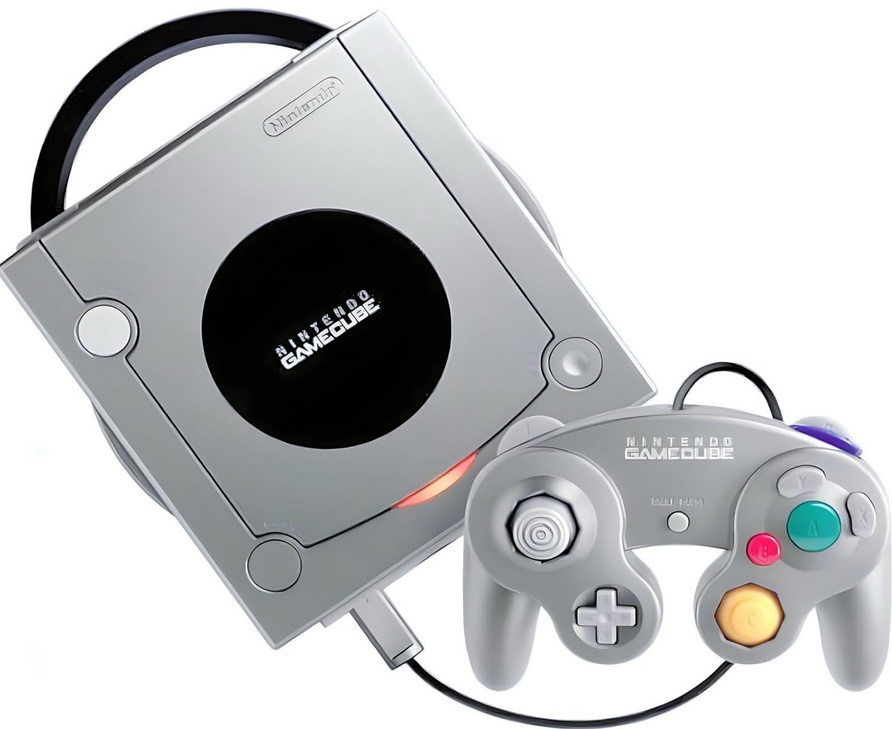
The GameCube’s physical design is immediately distinctive — a literal cube with a rounded handle built into its back panel, sitting low and compact on whatever surface it occupies, with a top-loading disc mechanism hidden under a hinged door that gives the console one of its most characteristic sounds: the quiet click-whir of the miniature optical drive spinning up a game.
The Platinum Colorway
The Platinum GameCube is the silver-grey variant released as an alternative to the launch Indigo purple colorway that defined the console’s initial North American market presence. Where the Indigo GameCube read as playful and colorful — a console making no apologies for being a toy as much as a technology product — the Platinum finish communicates something more restrained and neutral. The silver-grey body sits on entertainment centers without demanding visual attention, coordinates with the majority of home electronics aesthetics, and has aged into the collector’s market in particularly good condition because its neutral color hides minor scratches and wear marks more effectively than the deeper purple Indigo variant.
The Platinum controller — included in the complete bundle — extends the same color scheme to the input device, creating a cohesive hardware aesthetic that photographs well for collectors and looks intentional on shelf displays.
Build Quality and Physical Durability
The GameCube was built to a physical durability standard that reflected Nintendo’s traditional hardware philosophy: create products that survive the handling of children and the passage of time without requiring careful treatment. The compact, low-slung form factor reduces the leverage that drops and impacts create on the console body. The top-loading disc drive is protected by its hinged door from the dust accumulation that front-loading drives are more vulnerable to. The AV and power connectors use proprietary formats that seat securely and don’t loosen with repeated use the way generic connector standards sometimes do.
The practical result of this durability-focused design is visible in the secondary market today: refurbished GameCube consoles in excellent cosmetic and functional condition are readily available decades after the console’s discontinuation, because the hardware was built to last in a way that many of its contemporaries were not.
Technical Specifications in Detail
The GameCube’s processing architecture was built around a custom IBM PowerPC processor running at 485MHz, code-named Gekko. This processor was designed in close collaboration between Nintendo, IBM, and ArtX — a graphics chip company founded by former Silicon Graphics engineers who had worked on the Nintendo 64 graphics hardware — and represented a significant step forward in per-polygon performance and per-clock efficiency over its predecessor.
The external bandwidth specification of 3.2GB per second was among the highest available in any consumer device of the era and translated directly into the fast gameplay and minimal loading times that GameCube owners experienced compared to competing platforms. Loading times on the PlayStation 2, using standard DVD media with its longer seek times, were significantly longer than the equivalent loads on GameCube, where the faster mini-disc format and higher bandwidth architecture worked together to keep players in games rather than waiting for them.
The polygon rendering capability of six to twelve million polygons per second positioned the GameCube competitively against contemporary hardware. The range reflects the variability between simple scene rendering at the high end and complex rendering with full effects processing at the lower end — in practice, most GameCube games ran at the higher end of this range for normal gameplay and dipped toward the lower end only during extremely complex set pieces. The practical outcome was the absence of the frame rate drops and graphical slowdowns that had been a recurring issue on earlier Nintendo hardware.
The GPU — a custom chip called Flipper, also designed by ArtX — supported hardware-accelerated texture compression, multi-texture rendering, environment mapping, bump mapping, and real-time shadow computation. These capabilities gave the GameCube’s games their distinctive visual quality: not photorealistic in the way that some PlayStation 2 titles attempted, but clean, crisp, and artistically realized in ways that have aged extremely well compared to the muddier photorealism attempts of the same era.
The Mini-Disc Format
The GameCube’s use of proprietary 1.5GB mini-DVDs rather than standard DVD media was one of the console’s most controversial design decisions and, simultaneously, one of its most practically beneficial. The smaller disc size and non-standard format prevented piracy more effectively than standard DVD-based consoles, reduced manufacturing costs for game media, and enabled faster seek times and lower latency compared to full-size DVD reads.
For players, the mini-disc format meant essentially unnoticeable loading screens in games that other platforms would have required multi-second loads for — a quality-of-life improvement that felt seamless precisely because it was. For collectors today, the distinctive small size of GameCube game cases makes them immediately identifiable and creates a charming physical distinctiveness in a collection displayed on a shelf.
The GameCube Controller: The Most Debated Gamepad in Nintendo History
No aspect of the GameCube generates more passionate discussion among gaming enthusiasts than its controller — a device so unusual in its design choices and so effective in its specific applications that it has maintained an active user base long after the console itself was discontinued.
Physical Design Philosophy
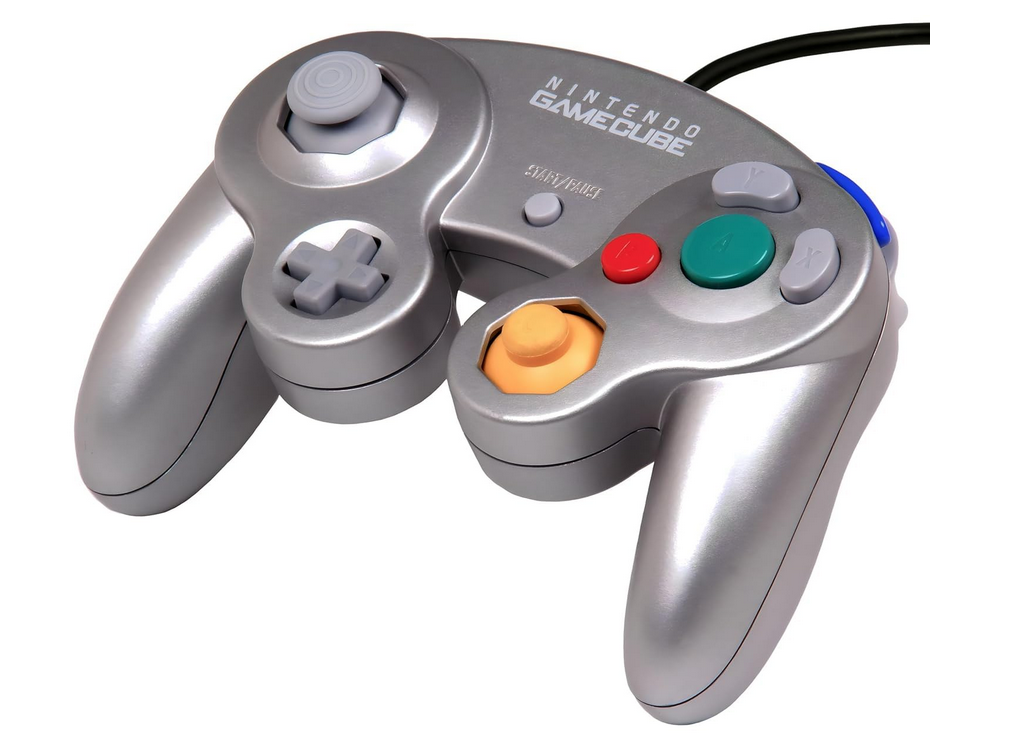
The GameCube controller is compact by the standards of its era and considerably smaller than the Xbox Controller S or the DualShock 2 that competed with it. The design philosophy was explicitly ergonomic rather than symmetric — the left analog stick is placed at the top-left position, aligned with the natural resting position of the left thumb, while the D-pad is placed lower and to the left, a concession that acknowledged the analog stick’s primary role in 3D game navigation.
The button arrangement is the controller’s most immediately striking feature: a large central A button in green, a smaller angled B button in red positioned to its lower left, and smaller X and Y buttons in grey positioned to the upper right of A. This asymmetric button hierarchy was explicitly designed to communicate importance — A is the primary action button, used for most fundamental game interactions, and its size literally communicates that primacy. The design was controversial at the time and remains so, but it produces a controller that, in the hands of experienced users, feels extraordinarily natural for the games it was designed to play.
The Analog Trigger System
The GameCube controller’s analog triggers are perhaps its most technically distinctive feature and the element that retro gaming enthusiasts most frequently cite when discussing the controller’s unique qualities. The L and R triggers travel a long physical distance and provide true analog pressure sensitivity along the full range of their movement, culminating in a digital click at the bottom of the travel that registers a full press separately from the analog range above it.
This dual-stage trigger design — analog range plus digital click — was used brilliantly by multiple first-party GameCube titles. Racing games could use the analog range for variable throttle and brake control. Action games could use the digital click for precise blocking inputs while using the analog range for variable shield positioning. The depth of the trigger travel also provided tactile feedback about how much pressure was being applied, which experienced players internalized as muscle memory after sufficient play time.
Modern controller designs have largely moved to shorter-travel triggers without the full analog range of the GameCube’s implementation, and the GameCube controller’s specific trigger feel is one of the most commonly cited qualities that brings players back to the original hardware rather than emulation alternatives.
The Controller’s Legacy in Competitive Gaming
The GameCube controller’s most remarkable post-lifecycle achievement is its continued active use in competitive Super Smash Bros. gaming. The Super Smash Bros. Melee competitive community — which maintains active tournament circuits more than two decades after the game’s release — plays almost exclusively on GameCube controllers, using official Nintendo GameCube Controller Adapters to connect them to modern Nintendo Switch hardware.
This is not mere tradition or nostalgia. Competitive Melee players cite specific physical properties of the GameCube controller — the analog stick’s gate geometry, the trigger travel and click position, the A button size and positioning — as functionally superior for the specific demands of Melee‘s advanced technique requirements. The fact that the controller remains the tool of choice for the highest level of play in one of gaming’s most technically demanding competitive games is a genuinely remarkable endorsement of its design quality.
The GameCube Library: A Case for the Greatest Software Concentration in Nintendo History
Any serious discussion of the GameCube has to spend significant time on its game library — because the software produced for this platform during its active years represents, in the opinion of many gaming historians and critics, the highest concentration of exceptional first-party titles Nintendo has ever produced in a single console generation.
The Legend of Zelda: The Wind Waker
The Wind Waker launched in 2003 to initial controversy — the cel-shaded art style was a departure from the realistic aesthetic that Ocarina of Time and Majora’s Mask had established, and vocal portions of the fan community complained bitterly before the game released. Within months of release, the controversy had inverted entirely. The Wind Waker is now widely considered among the most visually beautiful games ever made, its cel-shaded art style having aged with an elegance that the photorealism attempts of its contemporaries have not matched. The game’s open ocean exploration, its emotional storytelling, and its technical achievement in real-time toon shading created a benchmark for artistic direction in games that remains relevant today.
The Legend of Zelda: Twilight Princess
Twilight Princess represents the opposite aesthetic pole from Wind Waker — darker, more realistic, more overtly cinematic in its presentation. Released in 2006 simultaneously for GameCube and Wii, Twilight Princess is the last major first-party game released on the platform and stands as one of the most visually ambitious titles the GameCube hardware produced. The GameCube version remains the preferred format for players who want the experience without the Wii’s motion controls, and physical copies command significant collector interest.
Super Mario Sunshine
Super Mario Sunshine was the GameCube’s answer to the platformer question — a sequel to Super Mario 64 that traded the N64 game’s open-world structure for a more focused, stage-based tropical island setting with the FLUDD water-pack mechanics that divided critical opinion on release but have grown in appreciation over the subsequent years. The game’s movement system, built around the interaction between traditional platformer mechanics and the FLUDD’s directional water spray, is considered one of the deepest and most expressive movement systems in any 3D platformer, and players who invest in mastering it find a game significantly richer than its casual presentation suggests.
Metroid Prime
Metroid Prime may be the most technically and artistically impressive game the GameCube library produced, and it accomplished something that most gaming analysts considered impossible before its release: translating the atmospheric, exploration-focused Metroid formula into a first-person perspective without losing any of what made the series distinctive. The game’s atmospheric alien world design, its non-linear exploration structure, its combat system built around scanning and resource management rather than raw action, and its exceptional use of the GameCube’s graphical capabilities created a benchmark for atmospheric game design that influenced first-person game development for years afterward.
Super Smash Bros. Melee
Super Smash Bros. Melee is the GameCube’s most culturally enduring game — a title that launched a competitive gaming community that is still active today, still holding major tournaments, still drawing crowds, and still being played at the highest level on the original hardware by players who discovered it well after its original release. The game’s depth — a combination of accessible party game surface presentation and extraordinary technical ceiling — is one of the most studied phenomena in game design history, analyzed extensively by game theorists trying to understand how a game can be both casually enjoyable and competitively inexhaustible simultaneously.
Additional Library Highlights
Beyond these marquee titles, the GameCube library contains extraordinary games at every level of the catalog. Pikmin and Pikmin 2 created an entirely new real-time strategy genre that Nintendo has continued developing. Luigi’s Mansion was both a launch title and a genuinely inventive departure from traditional Mario platformer structure that spawned a franchise. Resident Evil 4 — multiplatform but GameCube-exclusive initially — is consistently cited as one of the most influential games ever made, its over-the-shoulder camera and action-survival genre fusion reshaping the industry.
F-Zero GX, developed in collaboration with Sega’s AM2 division, remains the standard against which every subsequent futuristic racing game is measured and found wanting. Paper Mario: The Thousand-Year Door is regularly cited by RPG enthusiasts as the finest game in the Paper Mario series. Animal Crossing, which came to Western markets first on GameCube, launched a franchise that remains among Nintendo’s most commercially successful. Chibi-Robo is a cult classic of extraordinary creative ambition. The list continues with titles that would be defining releases on any platform.
The Collector’s Market: What the GameCube Is Worth Today
The GameCube occupies a specific and interesting position in the retro gaming collector’s market — a console that was commercially available in large quantities during its production run, meaning hardware itself remains relatively accessible, but whose game library contains titles that have appreciated dramatically in value due to limited production runs, high demand, and the absence of legal re-release options for many key titles.
Hardware Valuation
Complete GameCube console sets — console, cables, and controller — are widely available through retro game retailers and the secondary market, with refurbished units in excellent condition available at prices that reflect the console’s accessibility rather than rarity. The Platinum colorway commands a modest premium over the Indigo in some markets due to its relative scarcity and its appeal to collectors who prefer the neutral aesthetic for display purposes.
Hardware condition is the primary value driver for GameCube consoles in the collector’s market. Units with intact original disc drives showing no signs of mechanical wear, original cables and controllers without damage, and minimal cosmetic wear on the console body command the highest prices. The GameCube’s robust build quality means excellent-condition units are more common in the secondary market than equivalent-condition examples of competing consoles from the same era, keeping hardware prices from reaching the extreme levels that some other retro consoles have hit.
Game Library Valuation
The GameCube game library is where serious collector attention is focused, and prices across the library have appreciated significantly over the past decade. Several factors drive this appreciation. Many high-quality GameCube titles were produced in relatively limited quantities, reflecting the console’s modest install base compared to the PlayStation 2. Nintendo has not made the majority of its GameCube library available through digital re-release channels, meaning physical media remains the only legitimate access point for most titles. And the growing nostalgia-driven demand from the generation that grew up with the platform has increased competition for physical copies.
Titles like Chibi-Robo, Pikmin 2, Baten Kaitos Origins, Cubivore, and various sports titles from the era have reached prices in the secondary market that significantly exceed their original retail cost. Even more mainstream titles like The Wind Waker, Super Mario Sunshine, and Metroid Prime command prices that reflect their classic status and continued demand.
For buyers interested in building a GameCube game library, sourcing games through retro game specialty retailers, estate sales, and local game stores typically offers better pricing than mainstream auction platforms where collector demand has driven prices to premium levels.
Playing the GameCube in 2026: Practical Setup Guide
Setting up a GameCube console for play in 2026 involves a few considerations that weren’t relevant during the console’s active production years — primarily around display compatibility and connection quality on modern televisions.
AV Cable Connection on Modern Televisions
The composite AV cable included in the standard GameCube bundle connects through the red, white, and yellow RCA connectors that most televisions produced before approximately 2018 included as standard inputs. Many current televisions have eliminated these legacy inputs in favor of HDMI-only connectivity, making a direct composite connection impossible without an adapter.
Several solutions exist for playing GameCube on modern HDMI-only displays. Component video — a five-cable connection using a separately available GameCube component cable — delivers significantly better image quality than composite and is supported by some current televisions. For the highest quality connection, HDMI adapters specifically designed for GameCube are available that upscale the console’s output to HDMI while maintaining the original image quality characteristics. The Carby and similar adapters are popular in the enthusiast community for this application.
Display Considerations
The GameCube outputs at 480i and 480p (progressive scan, supported by specific games through component cable) resolutions. On modern 4K and 1080p displays, this output will be upscaled by the television’s internal processing, with results that vary considerably by display model and the quality of the upscaling algorithm. External upscalers like the RetroTINK series are popular among enthusiasts who want the best possible image quality on modern displays, providing dedicated retro console upscaling that consistently outperforms television-internal upscaling for this application.
The GameCube’s art direction, which generally favored clean cel-shading and strong graphic design over photorealistic textures, holds up particularly well on modern displays compared to consoles of the same era that pursued photorealism — a quality of the platform’s software that makes the setup investment worthwhile for players who care about visual quality.
Audio Connection
The composite AV cable provides stereo audio through the red and white RCA connectors. GameCube supports Dolby Pro Logic II surround sound in games that were specifically programmed for it — a significant portion of the major first-party and third-party releases — through the same stereo audio output, requiring an AV receiver with Pro Logic II decoding to take full advantage. For players with surround sound systems, enabling Pro Logic II processing on compatible GameCube titles creates a noticeably more immersive audio experience than stereo playback alone.
The GameCube Community: Still Active, Still Passionate
One of the most remarkable qualities of the GameCube’s legacy is the vitality of the community that surrounds it more than two decades after the console’s release. The Super Smash Bros. Melee competitive scene operates active tournament circuits worldwide, attracting players who were not yet born when the game released and maintaining a level of community engagement that most contemporary titles never achieve. The speedrunning community has produced extraordinary Sunshine, Wind Waker, and Melee runs that continue to attract millions of views. Modding communities have produced software enhancements, texture packs, and expanded content for various GameCube titles that give familiar games new dimensions for returning players.
The GameCube homebrew community, enabled by various modchip and softmod solutions, has opened the platform to a range of customization and preservation activities that have helped digitize and preserve game content that might otherwise be lost to media degradation. This community activity is not unique to the GameCube, but it is particularly robust given the platform’s developer-friendly architecture and the passionate engagement of its fanbase.
Why the GameCube Platinum Belongs in Your Collection
The Nintendo GameCube Platinum console represents something specific and valuable in the retro gaming landscape: a complete, functional hardware platform that provides legal, authentic access to one of the most concentrated collections of exceptional games in Nintendo’s history, built around hardware that was genuinely excellent for its era and has proven to be extremely durable across the decades since its production.
For returning players — those who had a GameCube during its original production run and want to revisit games they loved — the platform delivers exactly the experience they remember, on hardware that functions identically to new in a well-maintained refurbished example, with the controller feel and startup experience that constitute the specific sensory memory of that era of gaming.
For new players discovering the platform for the first time — whether through recommendation, through curiosity about gaming history, or through the desire to experience titles like Melee, Wind Waker, or Metroid Prime in their original form — the GameCube provides access to experiences that remain genuinely extraordinary by contemporary standards, not as historical curiosities but as excellent games that hold their own against anything produced since.
The Platinum finish, the included controller, cables, and the compact physical presence of the console itself combine into a hardware package that earns its place on the shelf and in front of the television — not just as a collectible, but as a genuinely playable, genuinely enjoyable gaming platform that has outlasted the competitive landscape it was originally released into and emerged, with time and perspective, as the console that Nintendo fans are proudest to own.
Explore the Full World of Gaming at Game for Gamers
The Nintendo GameCube Platinum is one of the most beloved consoles in retro gaming history — but it represents one chapter within a much larger story of games, platforms, and play experiences worth knowing. Whether nostalgia brought you here, a collector’s instinct guided your search, or you simply want to understand why this compact silver cube has earned such passionate devotion from the generation that grew up with it, the same appreciation for quality gaming that drew you to the GameCube runs through everything we cover.
Game for Gamers is the complete resource for players of every kind — covering retro consoles and modern platforms alike, from Nintendo’s current Switch 2 lineup through PlayStation 5, Xbox Series X, and PC gaming hardware; tabletop and board games for every age group; collectible card games; educational toys for young children; and the full range of gaming peripherals from brands like Logitech G, Razer, SteelSeries, and Thrustmaster. Every guide and review on the site is written from the perspective of the actual player — honest about what a product delivers, specific about who it serves best, and focused on helping you make confident decisions whether you’re buying for yourself, shopping for a gift, or building a collection that reflects a lifetime of gaming passion.
What is included with the Nintendo GameCube Platinum Console?
The Nintendo GameCube Platinum Console bundle includes four components: the GameCube console itself in the distinctive Platinum silver-grey colorway, a power cable, an AV cable for connecting to a television, and one Nintendo Platinum controller. This complete bundle provides everything necessary to begin playing GameCube games immediately upon receipt, without requiring any additional cable or controller purchases. Games are sold separately and are not included with the console bundle.
What does the GameCube Platinum colorway look like?
The Platinum GameCube features a silver-grey color scheme across both the console body and the included controller — a clean, neutral aesthetic that differs from the more common Indigo purple variant that was the GameCube’s launch color in North America. The Platinum finish was released later in the console’s lifecycle and has become the preferred colorway for many collectors due to its understated appearance and versatility with different entertainment center setups. The controller matching the Platinum console uses the same silver-grey color scheme with the distinctive GameCube button layout in contrasting colors.
What television connection does the GameCube AV cable support?
The standard AV cable included with the Nintendo GameCube Platinum Console is a composite video cable — the standard red, white, and yellow RCA connector cable that connects to the corresponding AV inputs on most televisions. This connection type is supported by a wide range of televisions including many current models that maintain legacy AV inputs alongside their HDMI connections. For enhanced video quality, the GameCube also supports component video output through a separately available component cable, which delivers a significantly sharper image particularly on larger modern displays. The console also supports S-Video through a separately available S-Video cable for compatible televisions.
What are the GameCube’s key technical specifications?
The Nintendo GameCube is built around a custom IBM PowerPC-based processor running at 485MHz, capable of generating six to twelve million polygons per second depending on the complexity of the rendering task. The console’s external bandwidth of 3.2GB per second enables fast data transfer between components, contributing to the responsive performance and minimal loading times that GameCube owners consistently praised. The GPU — a custom ATI chip called Flipper — supports a range of graphical effects including bump mapping, environment mapping, and real-time hardware texture compression. The GameCube uses a proprietary mini-DVD format for its game media, which provides faster seek times than standard DVD formats and was part of Nintendo’s strategy for reducing load times across the platform.
What games are compatible with the Nintendo GameCube?
The Nintendo GameCube plays all standard GameCube game discs — the small proprietary mini-DVD format that houses the console’s game library of over 600 titles. The GameCube does not play standard DVD movies or CD audio. Notable GameCube titles that represent the platform’s library highlights include The Legend of Zelda: The Wind Waker, Super Mario Sunshine, Metroid Prime, Super Smash Bros. Melee, Luigi’s Mansion, Pikmin, Resident Evil 4, Paper Mario: The Thousand-Year Door, and F-Zero GX, among many others. The GameCube is not backward compatible with Nintendo 64 or Super Nintendo game cartridges, but the Nintendo Wii — which is itself backward compatible with GameCube games and controllers — can play the full GameCube library if you’re looking for a more recent hardware option that supports both platforms.
Is the Nintendo GameCube still worth buying in 2026?
For retro gaming enthusiasts, collectors, and players who want to experience the GameCube’s exclusive game library in its original hardware form, the GameCube remains absolutely worth purchasing. Several of the console’s most celebrated titles — including Super Smash Bros. Melee, which maintains an active competitive community, and games like Chibi-Robo and Cubivore that have never been re-released — are exclusively available on GameCube hardware or require it for the most authentic play experience. The console’s compact design, solid build quality, and iconic controller have earned it genuine affection from gaming communities worldwide. Physical GameCube games are widely available through retro game retailers and online marketplaces, making it straightforward to build a library after acquiring the console. For anyone who experienced the GameCube during its original release and wants to revisit those games, or for younger players discovering the platform for the first time, the console delivers a gaming experience that holds up genuinely well by any measure.
How does the GameCube controller compare to modern controllers?
The Nintendo GameCube controller is one of the most distinctive and beloved controllers in gaming history, and it remains highly regarded for specific use cases. Its most celebrated quality is its analog trigger system — two deeply recessed triggers that provide analog pressure sensitivity along the full range of their travel, a design that was used brilliantly in games like F-Zero GX and Wave Race: Blue Storm and that many players consider superior to the click-trigger designs that became standard in subsequent controller generations. The button layout, centered on the large A button with flanking smaller buttons for B, X, and Y, was optimized for the GameCube’s game library and feels natural for titles like Super Smash Bros. Melee that were designed specifically around it. The controller’s compact size and relatively light weight are appreciated by some players and less ideal for others who prefer larger controller forms. The GameCube controller remains actively used for competitive Super Smash Bros. play on modern Nintendo Switch hardware through a GameCube controller adapter, a testament to its enduring reputation for specific game types.
What should I know before buying a refurbished GameCube console?
Refurbished GameCube consoles go through a testing and inspection process to verify functionality before resale. Key things to confirm when purchasing a refurbished GameCube include whether all included cables are original Nintendo components or third-party replacements, the cosmetic grade of the console and controller, whether the disc drive has been tested with actual game media, and what warranty or return policy accompanies the purchase. Most reputable refurbished GameCube listings include the console, power cable, AV cable, and at least one controller — as this bundle does. Buyers who receive a properly refurbished GameCube typically report that the console performs identically to new hardware, as the GameCube’s solid mechanical design means that units in good working order often remain fully functional with no degradation in performance.
Customer Reviews
I debated this purchase for months. I had a GameCube as a teenager and loved it completely — it was genuinely one of my favorite possessions and some of the best gaming memories I have are from that era. When my parents gave it away after I moved out, I was honestly more upset than I let on at the time. I’ve been wanting to replace it for years but kept talking myself out of it.
I finally pulled the trigger, and I am so glad I did. This was my first refurbished electronics purchase and I went in cautiously — I’d heard mixed things and wasn’t sure what to expect. What arrived was packaged carefully, included the power cords and controller exactly as described, and had only one tiny scratch on the entire unit that I genuinely had to look for to find. I held my breath when I plugged it in, honestly expecting something to go wrong.
Everything worked perfectly. Exactly as I remembered. The games run smoothly, the controller feels exactly right in my hands, and spending an evening playing it brought back memories I hadn’t thought about in fifteen years. If you’re hesitating about a refurbished console the way I was — don’t. The experience was everything I hoped for and the quality genuinely surprised me.
My husband is a lifelong Nintendo fan and has been talking about wanting a GameCube again for as long as I’ve known him. When I saw this listed with the controller and cables included, I figured Christmas was the right time to finally make it happen. I’m not a gamer myself so I relied entirely on the listing description and the reviews from other buyers to make the decision — and I’m really glad I trusted them.
The console arrived in excellent condition and everything worked immediately when he set it up on Christmas morning. He already had a copy of Spider-Man 2 from his original GameCube days and it played without any issues. Watching him light up the way he did when everything booted up correctly was absolutely worth it. He’s played it almost every day since and hasn’t had a single issue. The controller is in great shape and the cables are all functional. For a gift purchase of a discontinued console I was genuinely nervous about, this could not have gone better. Highly recommend for anyone buying as a gift for a Nintendo fan.
I’ll be straightforward: I am fifty-four years old and I bought a refurbished GameCube because I wanted to play my old games again, and I have absolutely no regrets about that decision.
The console arrived in cosmetically excellent condition — genuinely impressive for a piece of hardware that has been discontinued for many years. The body shows minimal wear, the controller works exactly as it should, and the disc drive reads games without hesitation. I’ve been playing through titles I haven’t touched in years and the experience is every bit as enjoyable as I remembered. There is something genuinely special about going back to games you loved at a different stage of life and discovering they hold up completely.
The bundle included everything needed to get started immediately — power cable, AV cable, and the Platinum controller — and I was playing within minutes of unboxing. For anyone who grew up with the GameCube or simply missed it the first time around, don’t overthink it. The console is well-built, the games are excellent, and the refurbished quality is far better than the skepticism around buying used electronics might lead you to expect. Some of us just never outgrow good games.