
Anyone Can Play in Sixty Seconds Flat
The Left Right Center Game has one of the lowest barriers to entry of any group game ever produced — and that accessibility is its single greatest strength. The rules take under a minute to explain: roll the custom dice, pass chips left, right, or to the center based on what comes up, and be the last player holding any chips to win. That’s it. No reading required, no complex scoring system, no prerequisite knowledge of any kind. The Left Right Center Game has been played successfully by children as young as five and adults well into their eighties at the same table simultaneously — not because the game dumbs itself down for different ages, but because its core mechanic is genuinely universal. The dice roll the same way for everyone, and luck distributes itself without regard to age, gaming experience, or competitive instinct. For hosts looking for a game that requires zero explanation time and zero exclusion of any guest, the Left Right Center Game is the answer.
Portable, Durable, and Ready for Anything
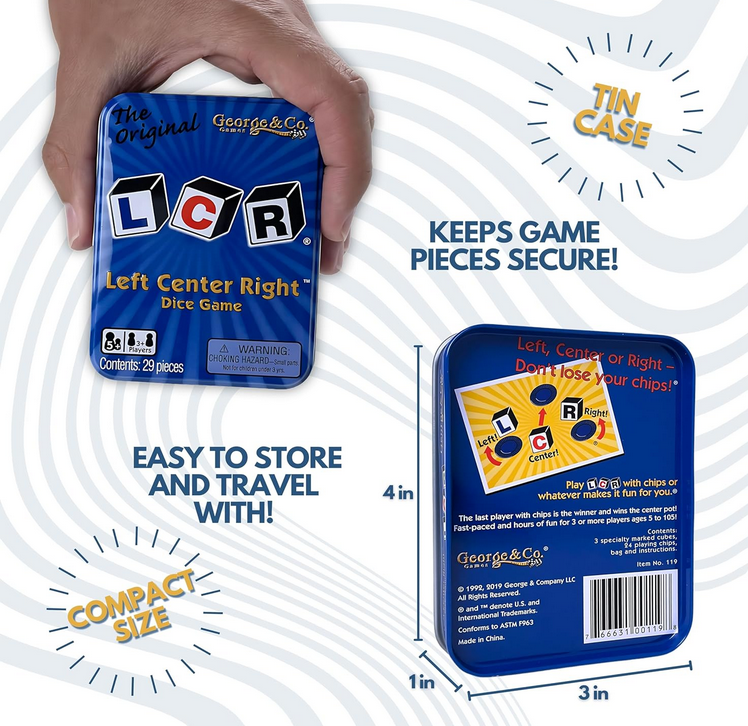
One of the most practical qualities of the Left Right Center Game is that it goes wherever you go — and it survives whatever happens when it gets there. The game is packaged in a compact metal tin that keeps the three specialty dice and the full set of chips organized, protected, and easily accessible. The entire package weighs just over four pounds in its standard configuration, fitting comfortably in a bag, a glove compartment, a camping kit, or a jacket pocket depending on the version. The metal construction of the container means it handles the kind of casual treatment that travel and outdoor gatherings produce without the cracking or warping that cardboard boxes can’t survive. From family road trips and camping weekends to holiday parties and office game nights, the Left Right Center Game is one of the few games genuinely designed — both in its mechanics and its packaging — for life outside the game room.
Endlessly Customizable Stakes Make Every Game Unique
What makes the Left Right Center Game particularly remarkable for social gatherings is its built-in flexibility around what you play for — and the way that flexibility transforms the stakes and the energy of every session. The game includes chips as the standard currency, but the real magic happens when players substitute something more personal: quarters for competitive adults who want real stakes, pennies or nickels for casual play, dollar bills for special occasions, or completely non-monetary items — potato chips, cookies, candy, or any small treat — for family-friendly sessions where the prize has edible appeal. This stakes flexibility means the Left Right Center Game can be pitched perfectly for the specific group and occasion, from a lighthearted after-dinner activity where the winner collects a bowl of snacks to a genuine money game where the pot builds across multiple rounds and the final winner takes everything. No other game in its category offers this level of contextual adaptability at this level of simplicity.
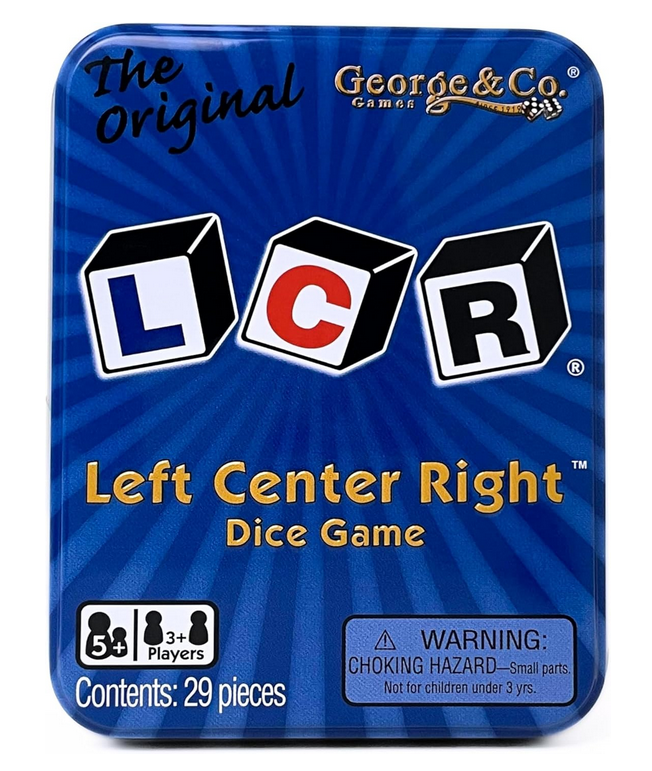
LCR® Left Center Right™ Dice Game – Blue Tin
Left Right Center Game: The Complete Guide to America’s Most Beloved Dice Game
There is a specific kind of game that earns its place not through complexity or elaborate components, but through the rare quality of working perfectly in almost every social situation imaginable. The Left Right Center Game is that kind of game. Simple enough to explain in under a minute. Exciting enough to hold the attention of a table of twelve for an hour. Flexible enough to work with six-year-olds, sixty-year-olds, and everyone in between. And portable enough to live in a bag, a glove compartment, or a camping kit rather than on a shelf waiting for the one night a month it gets played.
The Left Right Center Game — officially marketed as LCR® Left Center Right™ — has been a staple of American game nights, family gatherings, holiday parties, and casual social occasions for decades. Its premise is so straightforward that it barely qualifies as a ruleset: roll the dice, pass chips in the direction the dice indicate, and be the last player holding anything to win. And yet the social experience that unfolds around those simple mechanics — the tension of watching chips disappear from your pile, the collective gasp when a big roll clears the table, the unpredictable swing of fortune that can elevate or devastate any player on any turn — is genuinely compelling in ways that elaborate games with thick rulebooks sometimes fail to deliver.
This comprehensive guide covers everything there is to know about the Left Right Center Game: its history and origins, its complete rules, its many popular variants, the strategic thinking that experienced players develop, the best occasions and contexts for play, and the specific qualities that have made it one of the most consistently recommended casual games in America for multiple generations of players.
The History and Origins of the Left Right Center Game
The Left Right Center Game was developed and first published by George and Company LLC, an American game company. The game’s origins trace back to the early 1980s, when it was designed as a deliberately simple, accessible dice game that would work for large groups without the complexity barriers that prevented many games from being played by mixed-age, mixed-experience groups.
The design philosophy behind the Left Right Center Game was radical in its simplicity: create a game with no reading requirement, no strategy barrier, no setup time, and no component fuss that still produces genuine excitement and social engagement. The result was a game built around three custom dice and a pile of chips — components so minimal that they could be packaged in a tube or a tin small enough to fit in a jacket pocket.
The Left Right Center Game spread initially through word of mouth, exactly the distribution channel that its social nature was designed to support. Players who discovered it at a party brought it to the next gathering. Families who encountered it at a relative’s holiday dinner went home and ordered their own set. The game’s growth was organic, driven entirely by the quality of the experience it consistently delivered rather than by marketing campaigns or retail placement.
By the 1990s, the Left Right Center Game had established itself as a genuine American classic — a game that appeared at tailgates and camping trips, at retirement communities and college dormitories, at corporate team-building events and kindergarten classrooms. Its ability to work across all of these wildly different contexts without any modification is the defining achievement of its design.
Today, the Left Right Center Game is available in numerous editions — the classic tube, the metal tin, themed versions, oversized outdoor versions, and licensed variants — but the core mechanics have remained unchanged since the original design. That stability is itself a testament to the quality of the original concept: in over four decades of production, nobody has found a compelling reason to alter what works so well.
Complete Rules of the Left Right Center Game
Understanding the Left Right Center Game‘s rules fully takes about two minutes — which is part of the point. But covering them comprehensively ensures that every player starts on equal footing and that house rule disagreements, which have been known to derail more than one game night, don’t arise from incomplete initial explanation.
What You Need to Play
The Left Right Center Game requires three components:
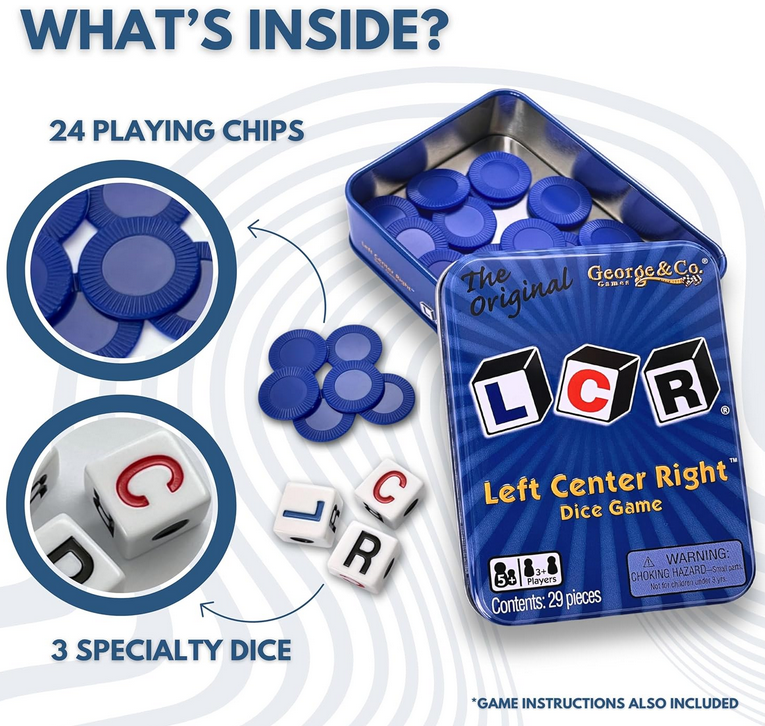
The Dice: Three custom six-sided dice, each face marked with either an L (left), R (right), C (center), or a dot (●). A standard Left Right Center Game die has two dot faces, one L face, one R face, and one C face, though this distribution can vary slightly between editions. The specific distribution of these faces is what calibrates the game’s flow — more dot faces mean slower chip movement and longer games; more directional faces mean faster chip redistribution and quicker resolutions.
The Chips: Each player starts with three chips. In standard play, these are the plastic or cardboard chips included with the Left Right Center Game. In popular variants, coins, bills, food items, or any small tokens of roughly equal size can be substituted for the included chips.
The Center Pot: A designated central area — typically the middle of the table — where chips sent to the center accumulate throughout the game. This pot is claimed by the ultimate winner.
Players: A minimum of three players is required for the Left Right Center Game to function as designed. With fewer than three, the passing mechanic loses its social dynamic. The upper player count is theoretically unlimited, though very large groups (fifteen or more) may find the time between turns creates engagement challenges.
Setup
Each player receives three chips before the game begins. No other setup is required. Players sit in a circle or around a table, establishing the left-right orientation that will govern chip passing for the entire game. Deciding who goes first can be handled any way the group prefers — youngest player, oldest player, whoever picks up the dice first, or a preliminary roll where highest result goes first.
Turn Sequence
On their turn, the active player rolls all three dice simultaneously — or fewer dice if they have fewer than three chips. The number of dice rolled equals the number of chips the player currently holds, up to a maximum of three. A player with zero chips does not roll at all on their turn; they are still in the game and can receive chips from adjacent players’ rolls.
For each die result:
L (Left): The active player passes one chip to the player immediately on their left.
R (Right): The active player passes one chip to the player immediately on their right.
C (Center): The active player places one chip in the center pot. Chips in the center pot are permanently removed from circulation — they are never redistributed and belong to whoever wins the game.
● (Dot): The active player keeps one chip. Nothing is passed or placed.
After processing all three dice results, play passes to the next player clockwise.
Winning the Left Right Center Game
The Left Right Center Game ends when only one player has chips remaining — either in their hand or on their immediate possession. That player wins the game and claims the center pot, plus whatever chips were passed to them during the final rounds.
A critical rule that many new players find surprising: a player with zero chips is not eliminated. They remain in the game and can receive chips from adjacent players whose dice rolls produce L or R results. This rule is what creates the Left Right Center Game‘s most dramatic moments — a player who appeared to be out of contention suddenly receiving chips back and returning to active competition with a shot at winning.
The One Die Rule
When a player has only one or two chips, they roll only the corresponding number of dice. A player with one chip rolls one die. A player with two chips rolls two dice. This rule prevents players from being mathematically eliminated too quickly in early turns and creates more opportunities for the unexpected comebacks that define the Left Right Center Game‘s most memorable sessions.
The Left Right Center Game Dice: Understanding the Probability
For players who want to understand the underlying mechanics of the Left Right Center Game more deeply, the probability distribution of the custom dice is worth examining — because it explains much of why the game feels the way it does and why certain patterns emerge across repeated sessions.
Standard Die Face Distribution
A standard Left Right Center Game die typically has the following face distribution: two dot faces, one L face, one R face, and one C face. This creates the following probabilities per die roll:
- Dot (keep chip): 2 in 6, or approximately 33%
- L (pass left): 1 in 6, or approximately 17%
- R (pass right): 1 in 6, or approximately 17%
- C (center pot): 1 in 6, or approximately 17%
- Directional result (any of L, R, or C): 4 in 6, or approximately 67%
This distribution means that on any single die roll, a player is more likely to lose a chip than to keep it. When rolling three dice simultaneously — the standard opening roll — the expected outcome is approximately two chips lost and one kept. This relatively rapid initial chip depletion is what gives the Left Right Center Game its pace and urgency, preventing the early game from dragging through extended periods where nothing significant happens.
Why the Dot Frequency Matters
The two-dot-face design is the most important calibration decision in the Left Right Center Game‘s design. Fewer dot faces would accelerate chip movement too much, creating extremely short games where luck dominates almost entirely in the first few rounds. More dot faces would slow the game to the point where sessions run too long and the middle game loses tension. Two dots per die creates the pacing sweet spot — games that resolve in ten to thirty minutes depending on player count, with enough movement to be exciting and enough retention to allow meaningful position changes across multiple turns.
Three-Dice Rolling Outcomes
When a player rolls all three dice simultaneously, the probability distribution across the most relevant outcomes works as follows: approximately 30% of three-die rolls will result in all three chips being moved or placed (no dots), approximately 44% will result in exactly one chip kept (two lost), approximately 22% will result in two chips kept (one lost), and approximately 4% will result in all three chips kept (all dots). The rare all-dot roll — statistically a roughly one-in-twenty-five event when rolling three dice — creates a disproportionate emotional response at the table that experienced players learn to celebrate appropriately.
Popular Left Right Center Game Variants
The Left Right Center Game‘s simple mechanic has inspired dozens of popular house rule variants that modify the stakes, the pacing, the winning conditions, or the social dynamics in ways that experienced players use to tailor the game for specific groups and occasions. Here are the most widely played and most consistently enjoyable modifications.
The Coin Variant
The most popular Left Right Center Game variant replaces the included chips with real currency. Each player starts with three coins of the same denomination — the most common choices are quarters for competitive adult play, dimes or nickels for casual family games, and pennies for young children or very casual sessions. The winner collects all coins from both the center pot and any coins remaining with other players at game end.
The coin variant transforms the Left Right Center Game‘s social dynamic significantly. When real money is on the line — even a modest amount — player investment in every roll increases noticeably. Groans at bad rolls become more emphatic. Celebrations at lucky results become more animated. The competitive edge that the coin variant introduces, even at penny stakes, creates exactly the kind of engaged, invested atmosphere that makes social games memorable.
For adult groups comfortable with higher stakes, dollar bill variants where each player starts with three single dollar bills creates a pot that can reach twelve to thirty dollars in a full game — meaningful enough to generate real excitement without requiring anyone to risk an uncomfortable amount.
The Food Variant
Replacing chips with small food items — most commonly potato chips, cookies, candy pieces, or crackers — is particularly popular in family settings with younger children and in casual party contexts where the appeal of winning edible prizes adds a different dimension of excitement.
The food variant of the Left Right Center Game has several practical advantages beyond simple novelty. Food tokens are universally available without any preparation. They create an inherently playful atmosphere that reduces competitive tension for groups where that tension might be unwelcome. And the stakes feel genuinely exciting to children in a way that abstract chips often don’t — winning a pile of cookies is a tangible, immediately enjoyable reward that motivates engagement throughout the game.
One practical note: some foods work better than others in the food variant. Individual-portion items (M&Ms, individual chips, small cookies) work well because they’re easy to handle and clearly countable. Avoid items that crumble easily, stick together, or are difficult to separate into individual tokens.
The Elimination Variant
In standard Left Right Center Game rules, players with zero chips remain in the game and can receive chips back from adjacent players. The elimination variant modifies this rule so that players who reach zero chips are genuinely out of the game — removed from the circle and unable to receive chips from subsequent rolls.
The elimination variant creates a faster-paced, more decisive Left Right Center Game experience at the cost of the unpredictable comebacks that many players consider the game’s most exciting feature. It works well for groups that want shorter sessions or find the standard “zero chips but still in” rule confusing or frustrating. For competitive groups who prefer more direct player elimination mechanics, the elimination variant provides a cleaner arc toward a decisive winner.
The Double Pot Variant
In this popular variant, any time all three dice on a single roll show C (an all-center roll), the player who rolled doubles the pot by adding three additional chips from outside the game. This rule — which triggers rarely due to the low probability of all three dice showing C simultaneously — creates a jackpot mechanic that makes large-pot moments even more dramatic when they occur.
The double pot variant works best with coin or dollar stakes, where the jackpot trigger feels genuinely significant. In chip play, the double pot is less emotionally impactful because the chips themselves carry no intrinsic value. For groups who want to add a rare but high-impact moment to the Left Right Center Game, the double pot variant delivers exactly that.
The Speed Variant
In the speed variant, players don’t wait for the previous player to finish passing before the next player rolls. Instead, play proceeds with each player rolling as soon as they receive their chips from the previous player’s pass, creating a continuous, overlapping flow of rolls and passes that dramatically accelerates the game’s pace.
The speed variant is not suitable for all groups — it requires comfort with the standard rules and a table configuration where simultaneous activity is manageable. But for experienced Left Right Center Game players who find the standard turn-by-turn pace too slow for large groups, the speed variant transforms the game into a genuinely frenetic activity that works particularly well at parties and large gatherings.
The Tournament Variant
For larger gatherings where a single Left Right Center Game session doesn’t accommodate the full group, the tournament variant runs multiple simultaneous games at separate tables, with the winner from each table advancing to a final championship round. This structure accommodates twelve to thirty or more players in a single organized event and creates a competitive arc across the full gathering that individual games can’t provide.
Tournament play works best with matched chip or coin stakes across all tables — standardizing the starting conditions ensures fair competition across the bracket. For holiday parties and corporate events where structured competitive play adds to the occasion’s formality, the Left Right Center Game tournament format is one of the most accessible and reliably enjoyable options available.
The Left Right Center Game Across Different Occasions
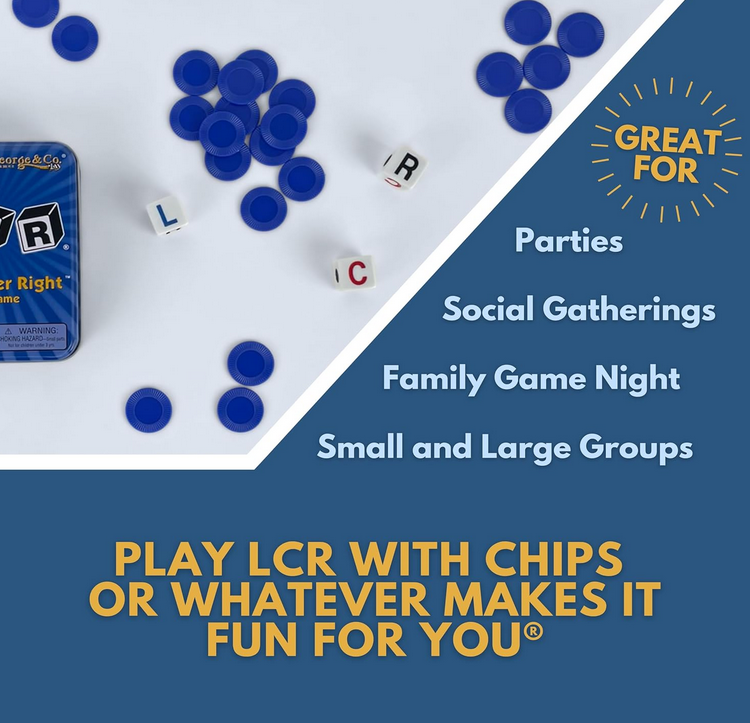
One of the Left Right Center Game‘s defining characteristics is its remarkable versatility — the same game that works for a family Thanksgiving dinner works equally well for a college dorm game night, a corporate team-building event, a camping trip, and a kindergarten classroom. Understanding how the game adapts to different contexts helps hosts deploy it most effectively.
Holiday Family Gatherings
Holiday gatherings are perhaps the Left Right Center Game‘s natural habitat. The mixed age range that defines most family holiday events — children, adults, and elderly relatives all at the same table — is precisely the context the game was designed to serve. The lack of any skill or knowledge component means no family member feels disadvantaged or left out based on age or gaming experience. The social dynamics of watching chips pass around the family circle, teasing the relative whose pile keeps shrinking, and celebrating the unexpected winner create exactly the kind of shared experience that holiday gatherings aim to generate.
The Left Right Center Game‘s compact packaging makes it easy to throw in the bag alongside food contributions or gifts, and its minimal setup time means it can be deployed spontaneously between dinner and dessert without requiring any advance preparation. For families who have struggled to find a game that genuinely works for everyone from eight-year-old grandchildren to eighty-year-old grandparents, the Left Right Center Game is one of the few options that consistently delivers.
Camping and Outdoor Gatherings
The Left Right Center Game‘s metal tin packaging and minimal component requirements make it one of the most practically suited games for outdoor and camping contexts. Unlike card games whose cards warp in humidity or blow away in wind, or board games whose pieces require stable flat surfaces and careful handling, the Left Right Center Game works on any surface — a picnic table, a log, a cooler lid — with no risk of component damage from the elements.
Outdoor Left Right Center Game sessions often benefit from the food variant, where snacks that were brought for the trip become the stakes and the winner claims a portion of the communal supply. This creates a natural integration between the social eating and the social gaming that camping contexts produce at their best.
Office and Corporate Events
Corporate team-building contexts present a specific challenge for game selection: the game needs to be simple enough that no employee feels excluded based on gaming experience, non-threatening enough that competitive dynamics don’t create awkward situations between colleagues of different seniority levels, and engaging enough that participation feels genuinely enjoyable rather than obligatory.
The Left Right Center Game meets all three criteria naturally. The pure luck mechanic means no employee wins because they’re smarter or more experienced — they win because the dice happened to favor them, which is a completely non-threatening form of competitive success. The social interaction of watching chips pass around the office table creates the low-stakes but genuine engagement that team-building activities aim to produce. And the coin or small-prize variant adds just enough stakes to create investment without creating pressure.
Children’s Parties and Classroom Settings
The Left Right Center Game works remarkably well in educational and children’s party settings when adapted appropriately. The elimination of monetary stakes in favor of food or toy prizes keeps the game age-appropriate, and the directional chip-passing mechanic provides a gentle, game-contextualized exercise in left-right orientation that has genuine educational utility for younger players.
For classroom use, the Left Right Center Game works particularly well as a reward activity, a social-skills exercise, or an end-of-period game that allows structured social interaction within clear rules. Teachers consistently report that children grasp the mechanics within a single demonstration round and remain engaged throughout play — a quality that many educational games claim but fewer actually deliver.
Bar and Party Settings
The Left Right Center Game‘s coin and bill variants are particularly well-suited to adult party and bar settings, where small financial stakes add competitive edge without requiring significant investment from any player. A group of six playing with three quarters each creates an eighteen-quarter pot — not life-changing, but significant enough to make every roll feel consequential and every win feel genuinely satisfying.
The game’s loud, social moments — the groans at an all-C roll, the cheers at an all-dot result, the teasing of whoever keeps losing chips to the center — create the kind of communal table energy that makes parties feel alive. The Left Right Center Game has been described by party hosts as “a game that announces itself” — you don’t need to keep score or maintain a leaderboard because the reactions happening around the table communicate the game state to everyone in earshot.
The Left Right Center Game and Social Dynamics: Why Simple Games Create Better Moments
There is a phenomenon in social game design that experienced party hosts and game enthusiasts eventually recognize: the games that generate the best moments are rarely the most complex or mechanically sophisticated. They’re the games with the simplest mechanics and the highest social amplification — games where what’s happening at the table produces genuine, spontaneous human reactions rather than calculated responses to complex stimuli.
The Left Right Center Game is a master class in social amplification. Every roll has an immediate, visible, emotionally legible consequence. When your pile shrinks, everyone sees it. When you receive chips back after appearing to be out, the table reacts. When the center pot grows large and the final players hold one chip each, the tension is palpable to everyone watching, not just to the players involved.
This social transparency — the quality of a game where everyone understands exactly what is happening and exactly why it matters — is what separates games that produce genuine connection from games that produce parallel individual experiences at the same table. The Left Right Center Game‘s mechanics are visible, immediate, and emotionally clear in a way that allows non-players watching from across the room to follow the drama without explanation.
The Teasing Dynamic
Experienced Left Right Center Game players know that the social dimension of the game extends well beyond the mechanics. The game creates natural opportunities for affectionate teasing — particularly of the player whose chips keep disappearing to the center, or the player who keeps passing their last chip to the same neighbor — that experienced family groups exploit mercilessly and lovingly in equal measure.
This teasing dynamic is not incidental to the game’s appeal; it’s central to it. The Left Right Center Game creates the specific social permission structure that allows adults to tease each other good-naturedly without anyone taking it seriously, because the underlying activity — rolling dice and passing chips — is so obviously arbitrary that no one’s dignity is genuinely at stake. The game produces the conditions for the kind of comfortable, affectionate ribbing that characterizes the best family and friend group dynamics.
The Comeback Mechanic as Narrative Engine
The Left Right Center Game‘s rule that zero-chip players remain in the game creates a narrative engine for individual sessions that pure elimination mechanics can’t produce. Every game has the potential for a comeback story — the player who was down to nothing, whose turn after turn produced no incoming chips, who sat empty-handed while others competed, and who then received a single chip from an L roll, another from an R, and suddenly was back in contention.
These comeback moments don’t happen in every Left Right Center Game session, but when they do, they become the story everyone tells afterward. The specific mechanics that produced them — the exact sequence of rolls, the precise positioning of players around the table, the turn of fortune that came at exactly the right moment — are the kind of game narrative details that players remember and retell in ways that game outcomes from more complex games rarely generate.
Choosing the Right Left Right Center Game Edition
The Left Right Center Game is available in multiple editions and packaging formats, each suited to slightly different use cases. Understanding the differences helps buyers choose the version that best fits their specific needs.
The Classic Tube Edition
The original Left Right Center Game packaging — a cylindrical cardboard or plastic tube containing the three dice and a set of chips — is the most compact and portable format available. The tube fits easily in a bag or large pocket and is the right choice for buyers who prioritize portability above all else. The tube edition is generally the most affordable and is the format that most players first encounter at parties and gatherings.
The Metal Tin Edition
The metal tin edition of the Left Right Center Game packages the dice and chips in a square or rectangular metal container with a hinged or sliding lid. The tin is more durable than the cardboard tube for frequent use and travel, keeps components more securely organized, and has a more premium feel that many buyers prefer for gift-giving purposes. The tin edition typically comes in multiple color options and is the version most commonly purchased as a gift.
Oversized and Outdoor Editions
Several Left Right Center Game variants feature oversized dice and larger chip formats designed for outdoor use — tailgates, backyard parties, beach gatherings, and camping contexts where standard-sized dice would be too easily lost in grass or sand. These outdoor editions sacrifice portability for durability and visibility, making them the right choice for groups who primarily play outdoors with large gatherings.
Themed and Licensed Editions
Numerous themed Left Right Center Game editions exist for specific holidays, sports teams, movies, and cultural moments. Christmas editions, Halloween editions, NFL team editions, and pop culture-licensed versions all play identically to the standard game but feature thematic dice faces, chip designs, and packaging that make them more appealing as gifts or seasonal purchases. For buyers who want the Left Right Center Game experience in a format that communicates something specific about the occasion or the recipient, themed editions are worth exploring.
Why the Left Right Center Game Belongs in Every Home
After decades in American game culture, the Left Right Center Game has earned its status as a genuine household essential — not through marketing or novelty, but through the consistent quality of the social experience it produces across an extraordinary range of contexts, player counts, ages, and occasions.
The game doesn’t require any particular skill to play. It doesn’t favor any particular type of player. It doesn’t demand any particular setting or surface or level of attention. What it demands is only the minimal willingness to roll dice, pass chips, and participate in the shared experience of watching fortune distribute itself unpredictably around a circle of people — an experience that has been generating laughter and connection at American tables for over four decades.
For new buyers, the Left Right Center Game represents one of the safest possible purchases in the casual games category: a proven product at an accessible price point with an effectively unlimited audience of potential players and a play experience that consistently delivers more entertainment than its simple mechanics suggest. It is the rare game about which virtually every person who has played it says the same thing: I had no idea something this simple would be this much fun.
For experienced players and game hosts, the Left Right Center Game is the anchor game — the one you pack automatically for every gathering, the one you reach for when the complicated games haven’t landed, the one that reliably produces the best moments of the evening without requiring any setup, explanation, or management. It earns its permanent place in the bag not by being the best game, but by being the most reliably good game — which, in practice, is worth more.
Conclusion: The Enduring Legacy of the Left Right Center Game
The Left Right Center Game is proof that the best design is not always the most complex. Sometimes the best design is the one that strips a concept down to its absolute essential core — in this case, the social pleasure of shared luck, communal stakes, and unpredictable fortune — and packages that core in the most accessible, portable, and flexible form possible.
Three dice. A pile of chips. A simple rule about passing left, right, or to the center. And four decades of American game nights, holiday gatherings, camping trips, office parties, and family tables producing exactly the kind of laughter, connection, and shared experience that the best social games are designed to create.
The Left Right Center Game has outlasted dozens of more sophisticated competitors, survived the rise of digital entertainment, and continued to find new players in each successive generation because it doesn’t rely on trend or novelty or technological sophistication to deliver its value. It relies on something much more durable: the fundamental human pleasure of sitting around a table with people you like, sharing a stake in an unpredictable outcome, and letting fortune determine who wins while everyone has a genuinely good time getting there.
That is what the Left Right Center Game offers. And after more than forty years, it still delivers it better than almost anything else in its category.
Explore More Games for Every Group and Every Occasion
The Left Right Center Game is one of the most reliably fun additions to any game collection — but it’s one piece of a much larger picture. Whether a friend’s recommendation brought you here, a party host pulled this tin out of their bag and you immediately wanted one for yourself, or you’re simply building the kind of collection that handles any social situation without a second thought, the same instinct that led you to a game this well-designed will serve you well across every category of play.
Game for Gamers is the complete resource for players of every kind — covering casual dice and party games like LCR through strategy board games, collectible card games, video games across every major platform, educational toys for young children, gaming hardware and peripherals, and everything in between. Every guide and review is written from the buyer’s perspective: honest, specific, and focused entirely on helping you find games that actually get played rather than games that simply look good on a shelf. Whether you’re shopping for a specific person, building out a game night kit, or simply curious what else belongs alongside the Left Right Center Game in a well-rounded collection, Game for Gamers is where that search belongs.
What is the Left Right Center Game and how do you play it?
The Left Right Center Game — officially known as LCR® Left Center Right™ — is a dice game for three or more players in which participants take turns rolling three custom six-sided dice and passing chips (or any chosen tokens) based on the results. Each die face shows either an L (pass one chip to the player on your left), R (pass one chip to the player on your right), C (place one chip in the center pot), or a dot (keep your chip). Players start with three chips each. You can only roll as many dice as you have chips, up to a maximum of three. The game ends when only one player has chips remaining — that player wins whatever is in the pot, or collects all the wagered items depending on how you’ve set up the stakes. The Left Right Center Game typically runs between ten and thirty minutes depending on player count and starting chip configuration.
How many players do you need for the Left Right Center Game?
The Left Right Center Game requires a minimum of three players and has no practical upper limit — larger groups simply make the game longer and more unpredictable, which most players find adds to the excitement rather than detracting from it. The game works particularly well in the four to eight player range, where rounds move quickly, the pot builds meaningfully, and the social dynamics of watching chips pass around the table create genuine tension and laughter. For very large groups at parties or family gatherings, multiple simultaneous games or a tournament format with winners advancing works well. The Left Right Center Game’s minimal equipment requirements mean scaling up to accommodate a large group is always straightforward.
What age is the Left Right Center Game appropriate for?
The Left Right Center Game is appropriate for ages six and up in standard play. The mechanics — roll dice, pass chips in the indicated direction — are simple enough for young children to grasp immediately, and the game moves quickly enough that younger players don’t lose interest between turns. At the same time, the Left Right Center Game offers no cognitive ceiling that makes it unstimulating for adults — the pure luck element and the social dynamics of watching the pot develop keep players of all ages equally engaged. Many families report playing with groups spanning ages six through eighty at the same table without any adjustment to the rules or mechanics. For younger children under six, the chip-passing mechanic may require minor adult guidance but remains accessible.
What can you use instead of chips in the Left Right Center Game?
The Left Right Center Game is designed to be played with any small tokens of roughly equal value, and players have developed an enormous range of substitutions that make the game work in different contexts. The most common alternatives include coins of any denomination — quarters for competitive play where the winner takes a meaningful amount, pennies or nickels for casual sessions — as well as dollar bills for special occasions where a bigger pot increases the stakes. Non-monetary options include candy, cookies, chips or crackers, small treats, or any small objects that can be distributed and collected. The flexibility to use real money is one of the Left Right Center Game’s most socially dynamic features, allowing the host to calibrate the stakes perfectly for the specific group and occasion.
How long does a game of Left Right Center take?
A typical Left Right Center Game session runs between ten and thirty minutes, with considerable variability based on player count and the number of starting chips. The standard three chips per player configuration produces relatively quick rounds — ten to fifteen minutes for most groups. For longer, more extended play, players can start with more chips per person, which builds the pot more substantially and extends the game. The Left Right Center Game’s short-to-medium runtime makes it ideal as an opener, a closer, or a between-activities game at parties and gatherings, while the option to extend play through starting chip adjustments means it can also serve as the main event when the group wants a longer session.
What is included in the Left Right Center Game?
The standard Left Right Center Game package includes three specialty dice — each marked with L, R, C, and dot faces — and a set of chips for each player. The game comes packaged in a compact metal tin that keeps all components organized and protected between sessions. The metal tin packaging is specifically designed for portability, making the Left Right Center Game easy to pack for travel, camping, parties, and outdoor gatherings without risk of components getting lost or the packaging getting damaged. The game does not include paper currency; players who want to play with cash bring their own, which is a common and popular variant.
Can the Left Right Center Game be played for real money?
Yes — playing the Left Right Center Game for real money is one of the most popular variants and is entirely consistent with how the game is commonly played in home settings. The typical setup involves each player starting with a set number of coins — most commonly quarters, but any denomination works — and the winner collecting everything remaining in the center pot at game end. The Left Right Center Game’s pure luck mechanic makes money play feel fair across all skill levels, since no player has a strategic advantage over another. For groups that want to play for cash without risking significant amounts, starting with smaller denominations like dimes or nickels keeps the game fun and low-stakes while maintaining the excitement of a real pot. Players looking to add more excitement to gatherings consistently report that adding a small monetary stake dramatically increases engagement and investment in every roll.
What makes the Left Right Center Game different from other dice games?
The Left Right Center Game distinguishes itself from other dice games through three specific qualities that most alternatives in the category don’t combine. First, its directional passing mechanic — chips moving left, right, or to the center based on dice results — creates a dynamic table environment where every player’s chip count is constantly changing in visible, interactive ways. Second, its pure luck structure means no player can claim a skill advantage, which keeps the social atmosphere light and eliminates the resentment that skill-based winning can create in casual group settings. Third, its stakes flexibility — the ability to play for chips, coins, food, or any small tokens — means the Left Right Center Game adapts its energy and investment level to the specific group rather than imposing a fixed play style. These three qualities together create the social magic that has made the Left Right Center Game one of the most consistently recommended party and gathering games across generations.
Customer Reviews
I’ve been to enough family gatherings where someone brings a game that requires twenty minutes of explanation and inevitably leaves half the group confused and the other half impatient. This was the opposite of that experience. We pulled out the Left Right Center Game after dinner with a group that included my seven-year-old nephew, my parents in their seventies, and everyone in between — and within literally two minutes of explaining the rules, everyone was playing and competing like they’d known the game for years.
The simplicity is the entire point, and it works completely. You roll, you pass chips where the dice tell you, and the last person holding anything wins. That’s it. And yet somehow it produces genuine tension with every roll — especially in the late game when only a few chips are left and they keep bouncing back and forth between players before someone finally holds on.
The tube packaging is excellent for travel. We were at a vacation rental and I had thrown it in the bag without thinking twice — which is exactly the kind of game this is. Fast, fun, zero setup, and it genuinely works for ages six to eighty without modification. One of the best casual game purchases I’ve made.
Look, this isn’t a complicated game and it’s not trying to be. What it is: the perfect game to pull out when you have a group of people, mixed ages, mixed gaming experience, and you want everyone actually playing and having a good time within two minutes of sitting down.
My family plays with whatever we have on hand. We’ve used quarters when the adults want a little competitive edge and the pot to mean something. We’ve used pennies for casual evenings when we just want to play something. We’ve used cookies with the younger kids, which makes the winner celebration a lot more delicious than usual. The Left Right Center Game doesn’t care what you use as currency — it just needs something to pass around the table.
The tin box is genuinely practical. I’ve thrown this in a bag for camping, brought it to a work party, and kept it in the console of my car for road trip stops. It’s the kind of game that earns its keep by being actually available when you want to use it rather than sitting in a box at home. Simple, fun, and consistently delivers. No notes.
I bought this for a birthday party that had guests ranging from my daughter’s friends (ages 6 and 7) to my parents and in-laws (60s and 70s), and I needed something everyone could actually play rather than something half the group would sit out. The Left Right Center Game solved that problem completely.
The tin keeps everything together which I really appreciate — the chips and dice all stay in one place and nothing gets lost between uses. The game is genuinely durable; it doesn’t feel like something that’s going to fall apart after a few uses.
What I love most is the flexibility. We played with the chips that come with it for most of the evening, then a few of the adults switched to dollar bills for a round and the energy immediately went up another level. The winner of that round was very pleased with herself. You can stretch the game out by giving everyone more starting chips or shorten it by starting with fewer — which means you can fit it into whatever time window you have.
One small note: the game doesn’t include fake cash, so if you want to play with paper money you’ll need to bring your own or grab some from a dollar store. Totally worth the extra five minutes — game night was genuinely one of the best we’ve had.