
A Physical Dexterity Game That Builds Real Cognitive Skills
The Tightrope Game by MindWare is the rare tabletop experience that feels like pure fun while quietly building the skills that matter most for growing minds. Every turn challenges players to carefully place a marble on one of the crisscrossing silicone bands stretched across the board — an action that demands hand-eye coordination, spatial awareness, and the ability to read a dynamic physical environment that shifts with every new marble added. But the Tightrope Game goes beyond simple dexterity: because the rubber bands sway and flex under load, players must think strategically about where each marble goes, anticipating how a placement on one band will affect the tension across the entire network. That combination of physical precision and forward-thinking decision-making is what MindWare designed the Tightrope Game to develop — and it’s why educators and parents consistently recommend it as a meaningful addition to both classroom and family game night settings.
No Two Games Are Ever the Same
What keeps players returning to the Tightrope Game session after session is a built-in variability that most games with this level of simplicity never achieve. Because the elastic band configuration changes between games — players can rearrange the paths the bands take across the board’s peg grid — the physical landscape of every Tightrope Game session is genuinely unique. A placement strategy that worked beautifully in the last game may fail entirely when the bands run in different directions across different pegs. This variability means experienced players can’t rely on a memorized winning approach and must read and respond to each specific board state as it develops. For children who play frequently — and the Tightrope Game is exactly the kind of game children play frequently — this replayability prevents the early mastery that often leads to boredom and shelf abandonment. The game stays fresh because the game is literally never the same twice.
Twenty Minutes, Total Engagement, Zero Setup Frustration
The Tightrope Game is designed for the way real families and real classrooms actually play. Its average play time of just twenty minutes means a complete game fits into a lunch break, a homework pause, a pre-dinner window, or a classroom activity period without running long or requiring anyone to commit to an extended session. Setup is fast — peg the board, stretch the bands, fill the marble cups, and play — and the rules are clear enough that most players are ready to start their first game within five minutes of opening the box. For parents managing children with different attention spans, teachers looking for classroom games that actually stay within a period, and families who want satisfying game night experiences without two-hour commitments, the Tightrope Game’s twenty-minute runtime is one of its most practically valuable qualities. And because rounds are short, the natural response to finishing a game is to immediately reset and play again — which is exactly what happens.
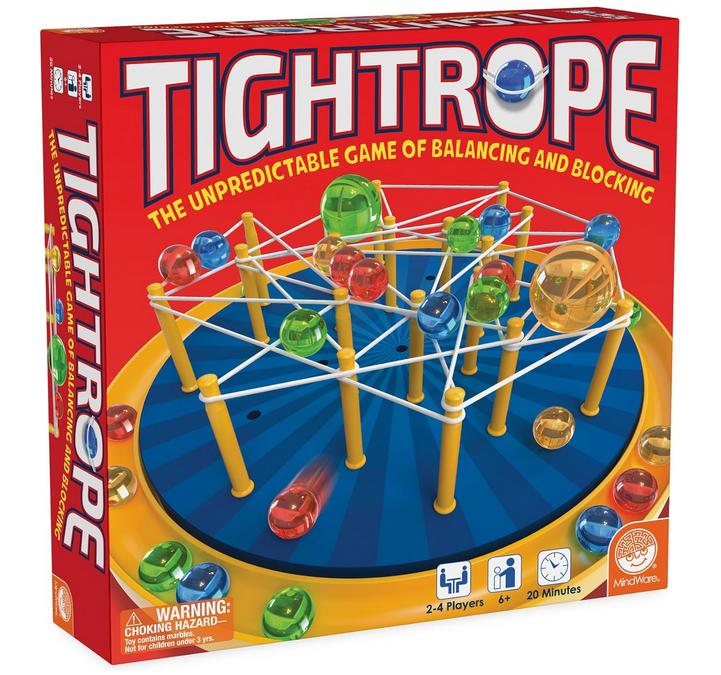
Tightrope Strategy Board Game, Fun for Classrooms, 2-4 Players, 20 Min Play Time, Ages 6 & Up
Tightrope Game: The Complete Guide to MindWare’s Marble-Balancing Strategy Game
Some of the best games ever made are built around the simplest possible premise. Not because simplicity is a limitation — but because simplicity, executed with genuine insight into what makes play engaging, creates experiences that are immediately accessible, endlessly replayable, and meaningful across age groups in ways that elaborate rule systems rarely achieve. The Tightrope Game by MindWare is exactly this kind of game.
Place marbles on elastic bands stretched across a pegged board. Don’t let them fall. Be the player with the fewest marbles left when someone finally places their last one.
That’s the Tightrope Game. Three sentences. And yet what unfolds across those twenty minutes of play — the mounting physical tension of bands bowing under increasing marble weight, the strategic calculation of where to place each piece for maximum effect, the gasps and laughter when a carefully balanced arrangement suddenly cascades — is a gaming experience rich enough to satisfy players from age six through adulthood, session after session, without ever quite playing the same way twice.
This comprehensive guide covers everything worth knowing about the Tightrope Game: its design philosophy, its mechanics, the cognitive skills it builds, who it serves best, how it compares to similar games, and the strategic depth that keeps experienced players coming back long after the rules have been mastered.
What Is the Tightrope Game?
The Tightrope Game is a physical dexterity and strategy board game produced by MindWare — a publisher with a long track record of creating games that combine genuine play value with meaningful educational development. The Tightrope Game supports two to four players, is designed for ages six and up, and runs approximately twenty minutes per session. It has become one of MindWare’s most consistently recommended titles for both family game night and classroom use, driven by the kind of enthusiastic word-of-mouth that only genuinely enjoyable games generate.
The core of the Tightrope Game is a game board fitted with twenty-four pegs across which players stretch twenty stretchy silicone bands in a crisscrossing pattern that creates the titular tightrope network. Each player begins with a cup of marbles — sixty-four small marbles and four big marbles are included in the Tightrope Game box — and takes turns placing marbles one at a time onto the elastic bands. The bands sway, bounce, and flex under the increasing weight and tension of accumulated marbles, making every placement progressively more precarious as the game advances toward its inevitable climax.
The winner of the Tightrope Game is the player with the fewest marbles remaining in their cup when any player successfully places their last marble. This reverse-objective structure — you win by getting rid of marbles rather than collecting them — creates a distinctive competitive dynamic in which every marble that falls from the bands during your turn returns to your cup, setting back your progress and potentially handing the advantage to a rival.
The Design Philosophy Behind the Tightrope Game
MindWare as a publisher operates with an explicit educational mission: creating games that develop cognitive and physical skills through engaging play rather than through instruction. The Tightrope Game represents this philosophy in particularly pure form, because every element of its design serves both the play experience and the developmental goal simultaneously.
The physical marble-balancing mechanic develops hand-eye coordination in a way that feels genuinely challenging rather than artificially constrained. Players must judge distances, apply calibrated pressure, and execute fine motor movements with deliberate precision — skills that are meaningfully exercised by the Tightrope Game‘s demands without feeling like physical therapy exercises dressed in game clothing.
The strategic layer — deciding where to place each marble for optimal effect — develops spatial reasoning and consequence anticipation in ways that are cognitively appropriate for children aged six through twelve while remaining genuinely engaging for adult players who bring more sophisticated analytical frameworks to the same decisions. The Tightrope Game doesn’t simplify its strategic layer for younger players; it presents the full complexity and allows players to engage with it at whatever depth their current cognitive development supports.
The competitive structure — multiple players simultaneously managing their marble counts while watching and responding to opponents’ placements — develops decision-making under social pressure, a skill that classroom environments and family game nights are particularly well positioned to cultivate. The Tightrope Game‘s short rounds mean that players experience multiple complete decision cycles in a single session, building real pattern recognition and strategic refinement across the arc of an evening’s play.

How the Tightrope Game Plays: A Complete Walkthrough
Understanding the Tightrope Game‘s mechanics in detail reveals why the experience is richer than the simple premise initially suggests.
Setup
Setting up the Tightrope Game begins with placing the game board on a flat, stable surface — a requirement worth emphasizing, as an uneven playing surface introduces artificial tilting that compromises the marble balance mechanics and creates frustration rather than challenge. Players insert the twenty-four pegs into the board according to the included configuration guides, then stretch the silicone bands between pegs to create the crisscrossing tightrope network that forms the playing field.
The band configuration is one of the Tightrope Game‘s most valuable design features: it is variable between sessions. By changing which pegs the bands connect and therefore how they cross and interact across the board, players create a unique physical landscape for every game. A band path that created a particularly stable central zone in one session may become the most volatile area of the board in the next, depending on how surrounding bands are routed.
Each player receives a marble cup filled with their starting marble allocation, and the Tightrope Game is ready to begin.
Turn Structure
On each turn in the Tightrope Game, the active player selects one marble from their cup and places it on any band on the board. This sounds straightforward — and mechanically, it is. The complexity comes from the physical reality of the bands themselves.
Silicone elastic bands stretch, sway, and respond to load in ways that are partially predictable through physics and partially variable through the natural inconsistency of elastic materials under stress. A band with six marbles already balanced on it responds very differently to a new addition than a band with one. A band that crosses two other loaded bands at its midpoint is under compound tension from multiple directions. A marble placed near the center of a long band span experiences more sway than one placed near a peg anchor point.
Reading these physical variables accurately — developing an intuitive model of how the current board state will respond to specific new placements — is the core skill that the Tightrope Game develops over repeated sessions and that separates experienced players from beginners in competitive play.
The Fall Consequence
If any marbles fall from the bands during a player’s turn — whether the marble being placed, or existing marbles disturbed by the new placement’s effect on band tension — those fallen marbles return to the active player’s cup. This consequence mechanic is the Tightrope Game‘s primary competitive driver: it punishes careless or unlucky placements by reversing progress and creates the escalating tension that makes late-game turns genuinely nerve-wracking.
The fall consequence also creates strategic opportunity. Because fallen marbles go to the player whose turn it is, not to the player who placed the marble that caused the cascade, experienced Tightrope Game players actively look for placements that will overload already-stressed bands and cause existing marbles to fall — deliberately triggering avalanches on their own turn when they calculate that the marbles returned to their cup will be fewer than those that remain on the board for opponents to deal with.
This offensive use of the fall mechanic — treating marble falls not as a failure to be avoided but as a tool to be deployed strategically — is the conceptual shift that marks the transition from novice to experienced Tightrope Game play.
Winning the Tightrope Game
The Tightrope Game ends immediately when any player places their last marble successfully on the bands without causing any falls. At that point, all remaining players count the marbles in their cups, and the player with the fewest marbles remaining wins. This ending structure means the game can conclude at any moment from the mid-game onward, creating sustained tension across the entire second half of each session as players simultaneously race to empty their own cups and manage the board state to prevent opponents from doing so first.
The Elastic Bands: The Physical Heart of the Tightrope Game
No element of the Tightrope Game deserves more attention than the silicone elastic bands that form its playing surface — because the physical behavior of these bands is what creates everything distinctive about the game’s experience.
Why Elastic Rather Than Rigid?
A rigid wire or string tightrope would create a completely different — and significantly less interesting — Tightrope Game. Rigid surfaces can be loaded to predictable tolerances; once a player understands the physics of a rigid surface, they can calculate safe and unsafe placements with high confidence. The game would quickly become a solved puzzle rather than a genuinely dynamic challenge.
Elastic bands introduce variability that cannot be fully predicted or controlled. The same band, loaded with the same marbles in the same positions, will respond differently to a new marble addition depending on how it has been stretched and relaxed across prior turns, how the crossing bands are currently loaded, and the precise angle and pressure of the new placement. This controlled unpredictability — variability within understood physical parameters — is what keeps the Tightrope Game challenging across hundreds of sessions and what ensures that physical intuition, developed through repeated play, never fully eliminates the element of genuine uncertainty.
Durability and Performance Over Time
The silicone bands used in the Tightrope Game are well-chosen for their application. Silicone elastic maintains its stretch properties better than natural rubber over time and repeated use, resists the brittleness that causes older rubber bands to snap, and provides consistent tactile feedback that players develop sensitivity to over repeated sessions. Regular players report that the bands perform consistently well through dozens of sessions without significant degradation in their elastic properties.
The Sound Dimension
An underappreciated quality of the Tightrope Game is its acoustic dimension. The twang and vibration of a loaded band when disturbed, the sharp click of marble against marble during a close placement, and the cascade of glass marbles rattling across the board during an avalanche create a sonic experience that adds to the physical tension of play. These sounds are not incidental — they serve as feedback signals that experienced players learn to read, providing information about band tension and marble stability that supplements the visual assessment of the board state.
The Marbles: Size, Weight, and Strategic Differentiation
The Tightrope Game includes two sizes of marble: sixty-four small marbles and four big marbles per player set. This size differentiation is not merely cosmetic — the two marble types have different physical properties that affect both their behavior on the bands and their strategic value during play.
Small Marbles
The small marbles are the primary currency of the Tightrope Game. Their lighter weight means they exert less downward force on the bands, making them safer to place in precarious positions — but their smaller contact surface area also means they have less friction against the elastic band surface, making them more likely to roll or slide when the band sways after placement. The strategic calculation around small marble placement involves balancing these competing properties: lighter load, but less stable seating on the band.
Big Marbles
The big marbles carry more weight and exert more downward force on the bands when placed, making them higher-risk placements in terms of the tension they add to the band network. However, their larger surface area provides better contact with the band, potentially making them more stable once seated. Experienced Tightrope Game players develop specific strategies around big marble timing — holding them for moments when the board state can absorb their weight, or placing them early to establish heavy anchors that shape the rest of the game’s dynamics.
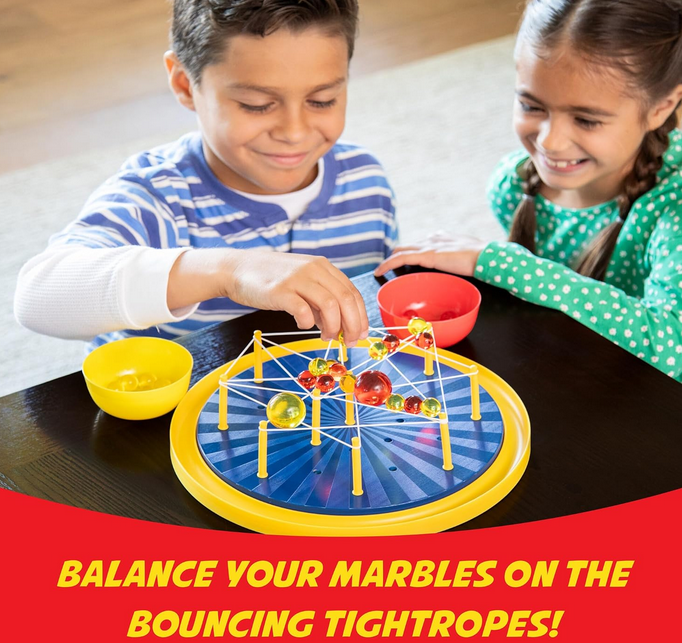
Strategic Depth in the Tightrope Game: From Beginner to Advanced Play
The Tightrope Game presents an interesting strategic learning curve: the basic rules are learnable in minutes, but the strategic depth that emerges from those rules takes many sessions to fully explore. This section maps that learning curve from first-time play through advanced competitive strategy.
Level 1: Basic Play — Avoiding Falls
The first strategic lesson most Tightrope Game players learn is simple: identify the bands with the most marbles already on them and avoid adding to them. This conservative approach — minimizing personal risk by targeting the emptiest, most stable bands — is the natural default of first-time players and is a reasonable starting point for children on the younger end of the age range.
The limitation of pure defensive play becomes apparent quickly in competitive sessions. If every player is targeting the same empty bands to minimize their own fall risk, those bands fill rapidly and become just as dangerous as the originally loaded ones. Conservative players who never develop beyond pure risk avoidance find themselves running out of safe options simultaneously with everyone else, without having gained any strategic advantage from their caution.
Level 2: Tactical Play — Reading the Board
The second strategic layer involves developing accurate assessment of the current board state — understanding not just which bands are loaded, but which specific positions on which bands represent the most unstable marble arrangements and therefore the highest fall probability for the next player who disturbs them.
Tightrope Game players at this level start paying attention to the shape and tension of individual bands: a band bowed deeply under heavy central loading is near its failure point; a band carrying marbles clustered near one peg anchor rather than distributed along its length is under asymmetric tension that makes it unpredictable. Reading these board state details accurately allows tactical players to identify which areas of the board are genuinely safe versus which merely appear safe based on raw marble count.
Level 3: Strategic Play — Offensive Marble Management
Advanced Tightrope Game players think beyond their own marble cup and actively manage the board state to create fall opportunities for opponents while protecting the placements they’ve made themselves.
The core offensive strategy involves targeting specific bands that are near their loading threshold — adding the marble that tips an already-stressed band into instability and causes a cascade during your own turn. While this sounds counterproductive (the fallen marbles return to your own cup), the calculation changes dramatically when the cascade affects multiple bands and returns fewer marbles to your cup than it removes from bands that opponents were counting on for their own future placements.
This offensive marble management requires sustained board awareness across multiple turns, tracking which bands are approaching threshold, anticipating what placements opponents are likely to make, and timing offensive placements for maximum disruption with minimum personal cost.
Level 4: Band Configuration Strategy
The highest level of Tightrope Game strategic thinking operates at the setup phase rather than during play itself — choosing band configurations that favor a specific player’s tactical style or that create board dynamics advantageous to their overall approach.
Players who favor aggressive offensive tactics prefer band configurations with many crossing points and shared anchor pegs, because these configurations create more interconnected tension dynamics and more opportunities for chain-cascade effects. Players who favor conservative accumulation prefer configurations with longer, more independent band spans that can be loaded more heavily before reaching instability.
Understanding how setup choices shape play dynamics — and using that understanding to configure the board advantageously before the first marble is placed — is the most sophisticated dimension of Tightrope Game strategic development.
The Tightrope Game in Educational Settings
MindWare designed the Tightrope Game explicitly for classroom use alongside family entertainment, and it delivers genuine educational value in school environments that many games claim but fewer actually provide.
Curriculum Alignment
The Tightrope Game aligns naturally with several areas of elementary and middle school curriculum development. The physical mechanics provide hands-on exploration of basic physics concepts — elasticity, load distribution, center of gravity, and the relationship between force and deformation are all observable in real time during play. Teachers who integrate the Tightrope Game into STEM curriculum can use it as a concrete demonstration platform for these concepts before transitioning to more abstract representations.
The strategic layer aligns with mathematical thinking development — specifically the probabilistic reasoning involved in assessing which placements are more or less likely to cause falls, and the optimization thinking involved in making the best possible move given the current board state. These are genuine mathematical reasoning skills that the Tightrope Game develops through intrinsically motivated play rather than through instruction.
Social-Emotional Learning
Beyond cognitive development, the Tightrope Game provides valuable social-emotional learning opportunities in classroom contexts. The game’s structure requires players to manage frustration when marble falls reverse their progress, to demonstrate gracious competition when opponents succeed, to take turns patiently in a context where the wait between turns is genuinely suspenseful, and to engage in strategic thinking under mild social pressure — skills that are central to social-emotional learning curricula at the elementary level.
The Tightrope Game‘s short play time allows multiple complete rounds within a single classroom period, giving students repeated opportunities to practice these social-emotional skills across different competitive outcomes within a single session.
Inclusive Play
One of the Tightrope Game‘s most valuable qualities for classroom use is its accessibility across different learning profiles. Students with strong spatial reasoning who might struggle in language-heavy games find the Tightrope Game‘s visual and physical emphasis plays to their strengths. Students with strong fine motor skills but less developed strategic thinking can contribute meaningfully through precise physical execution even before their strategic understanding catches up. The game creates multiple paths to meaningful participation that inclusive classroom environments actively benefit from.
Tightrope Game vs. Comparable Dexterity Games
Understanding where the Tightrope Game sits within the broader landscape of dexterity games helps buyers assess whether it’s the right addition to their collection and how it complements other games they might already own.
Tightrope Game vs. Jenga
Jenga is the most widely played structural dexterity game and the natural comparison point for any game involving physical stability challenges. Both the Tightrope Game and Jenga build tension through progressive structural loading and resolve in a dramatic collapse moment. The key differences are the direction of action (Jenga removes blocks; the Tightrope Game adds marbles), the nature of the playing surface (rigid wood tower versus elastic band network), and the strategic layer (Jenga’s strategy is primarily tactile reading of block resistance; the Tightrope Game adds spatial planning about where on the network to place). For households that already own Jenga and want a complementary dexterity experience with different physical mechanics and strategic texture, the Tightrope Game is an excellent addition rather than a replacement.
Tightrope Game vs. Suspend
Suspend is another MindWare dexterity game in which players hang notched rubber pieces from a tabletop stand. Like the Tightrope Game, it involves building a precarious structure that becomes increasingly unstable as play progresses. The Tightrope Game differs from Suspend primarily in its use of marbles rather than hanging pieces — creating a rolling and falling dynamic rather than a swinging and tipping one — and in the configurable band network that provides variability Suspend doesn’t offer. Both games share MindWare’s educational DNA and are complementary rather than redundant in a family game collection.
Tightrope Game vs. Marble Run Construction Sets
Marble runs focus on construction and cause-and-effect observation rather than competitive strategy. Children who enjoy marble runs often take to the Tightrope Game readily because both products leverage the intrinsic appeal of marbles in motion, but the Tightrope Game adds the competitive and strategic dimensions that pure construction sets don’t provide. The Tightrope Game is an excellent next step for children who have outgrown the novelty of marble run construction and are ready for a genuine game structure.
Who Is the Tightrope Game For? A Complete Buyer’s Guide
Children Ages 6–9: The Primary Audience
Children in the six to nine range are the Tightrope Game‘s primary and most enthusiastic audience. At this age, the physical dexterity challenge is appropriately calibrated — neither too easy to be boring nor too demanding to be discouraging — and the strategic layer is accessible enough to engage without overwhelming. Children in this range who play the Tightrope Game regularly show measurable improvement in both physical precision and board-reading accuracy across sessions, which creates the visible progress narrative that sustains long-term engagement with any game.
For children on the younger end of this range — six and seven-year-olds — adding an extra elastic band per player as some families report doing can make the network slightly more forgiving without removing the fundamental challenge. This simple modification extends the Tightrope Game‘s age accessibility downward without requiring any change to the core rules.
Children Ages 10–13: The Strategic Development Window
Older children bring more sophisticated strategic thinking to the Tightrope Game and tend to engage more deeply with its competitive dimensions. Tweens who have progressed through simpler games are often looking for something that offers genuine strategic challenge without the complexity barrier of more adult-oriented games, and the Tightrope Game sits in exactly that space. The physical skill component also means that strategic sophistication doesn’t automatically translate to competitive dominance — a younger sibling with steadier hands can compete meaningfully against an older one with better strategic thinking, which keeps the game viable across sibling age gaps.
Families with Mixed Ages
The Tightrope Game is one of the more reliably successful mixed-age family games available in its price range. Its success with groups spanning from age five through eighty-five — as multiple reviewers attest — stems from the same physical immediacy that makes it accessible to children. The challenge of balancing marbles on elastic bands doesn’t require shared cultural references, common vocabulary, or equivalent levels of formal education. It requires attention, physical care, and basic spatial reasoning, all of which function across generational divides more reliably than most game mechanics.
Classroom Teachers and Educational Professionals
For educators specifically, the Tightrope Game offers a combination of features that most classroom game purchases fail to deliver simultaneously: short enough to complete within a period, educationally justifiable across multiple developmental domains, accessible to students across a range of learning profiles, self-contained with minimal setup, durable enough for frequent use, and genuinely engaging enough that students want to play rather than feeling like they’re doing a learning activity. This combination makes the Tightrope Game one of the most consistently recommended classroom game additions in the elementary and middle school range.
Gift Buyers
The Tightrope Game is an excellent gift for children aged six through twelve and for families with children in that range. Its price point is accessible, its quality is evident from the component set, and its appeal is immediate enough that recipients understand the game’s appeal within minutes of opening the box. The educational dimension gives adult gift-givers a clear articulation of why the game is a good choice beyond simple entertainment value, which matters in gifting contexts where thoughtful educational intent is appreciated. The Tightrope Game works particularly well as a gift for screen-heavy households where parents are actively looking for engaging alternatives that don’t involve devices.
Practical Tips for Getting the Most from the Tightrope Game
Surface Selection
As noted consistently across player feedback, the Tightrope Game‘s most important practical setup requirement is a genuinely level playing surface. A kitchen or dining room table that passes a visual level check is usually sufficient, but if you notice marbles consistently rolling toward one side of the board during play, place a thin book or folded cloth under the lower edge to compensate. The game should reward careful marble placement, not compensate for a tilted board.
Band Configuration Experimentation
New players often use the same band configuration across their first several sessions because it’s the one they set up initially. Experienced players actively vary configurations between games, both to experience different strategic challenges and to identify configurations that suit the skill levels of the specific players at the table. A tighter, more interconnected network creates more cascade opportunities; a looser network with longer independent bands creates more independent decision-making. Finding the configurations your group enjoys most is part of the Tightrope Game‘s long-term engagement value.
Marble Management Strategy
Beginning players tend to place marbles as quickly as possible, prioritizing speed over placement quality. More effective play slows down during critical late-game moments, taking the time to assess band tension and identify the most favorable placement position rather than defaulting to the first apparently safe option. The Tightrope Game rewards deliberate play more consistently than fast play, particularly once the board is significantly loaded.
Teaching Younger Children
For children on the younger end of the Tightrope Game‘s age range, cooperative play before competitive play is an effective introduction. Having all players work together to see how many marbles the band network can support before any fall — without the pressure of competition — teaches the physical mechanics and builds confidence before the competitive structure is added. Most younger children who start with this cooperative introduction transition to competitive play more smoothly and with more enjoyment than those who encounter the competitive structure first.
The Tightrope Game’s Place in the Modern Board Game Market
The board game market of 2026 is characterized by extraordinary diversity — a product range spanning simple children’s games through six-hour strategic simulations, covering every possible theme and mechanic, at price points from a few dollars through several hundred. Within this landscape, the Tightrope Game occupies a position that the market consistently needs and never fully saturates: the genuinely excellent family dexterity game that works across age groups, develops real skills, and delivers consistent play value across dozens of sessions.
The physical dexterity game category has experienced renewed interest in recent years as families increasingly seek screen-free entertainment that provides genuine hands-on engagement. The Tightrope Game benefits from this trend while offering more than most dexterity games: its strategic layer means it isn’t purely a test of physical skill, its educational justification makes it a defensible purchase for parents who are selective about game investments, and its configurable band network means it doesn’t exhaust its novelty after a handful of sessions.
MindWare’s track record as an educational game publisher also provides the Tightrope Game with a degree of institutional credibility that purely commercial game publishers don’t always command in the educational market. When teachers and educational professionals recommend the Tightrope Game for classroom use, they’re drawing on that track record as much as on the specific qualities of the game itself.
Final Assessment: Is the Tightrope Game Worth Your Investment?
The Tightrope Game earns an unambiguous recommendation across every buyer category it targets. For families seeking a genuinely engaging game that works from age six through adulthood, develops real cognitive and physical skills, and offers meaningful variability across repeated sessions, the Tightrope Game delivers on every criterion. For educators seeking a classroom game that fits within activity periods, aligns with developmental learning goals, and maintains student engagement across repeated exposures, the Tightrope Game is among the best options available in its price range.
The physical immediacy of marble-on-elastic-band play — the sway, the tension, the cascade — creates a game experience that is difficult to fully convey in text and that players consistently describe as exceeding expectations on first encounter. The strategic depth that emerges from repeated play ensures that initial enthusiasm doesn’t fade as the novelty wears off. And the configurable band network means that the specific physical challenge of the Tightrope Game genuinely never exhausts itself across the lifespan of ownership.
Some games earn their place through elaborate production. Some through deep strategic complexity. The Tightrope Game earns its place through the combination of physical delight and genuine strategic engagement that emerges from twenty elastic bands, sixty-eight marbles, and the simple, endlessly compelling challenge of keeping everything balanced just a little while longer.
Discover More Games for Every Player at Game for Gamers
The Tightrope Game is one of the most satisfying dexterity strategy games available for families and classrooms — but it’s one title within a much larger world of games worth exploring. Whether you came here through a friend’s recommendation, a gift search, or simply the appeal of a marble-balancing challenge that genuinely delivers on its premise, the instinct that brought you to a game this well-designed will serve you well across every category of play.
Game for Gamers is the complete resource for players of every kind and every age. From physical dexterity games and strategy board games through collectible card games, building sets, video games across every major platform, and the gaming hardware that enhances those experiences — everything is covered in one place, evaluated from the buyer’s perspective, and organized to help you find the right game for the right person at the right moment. Whether you’re building a family game library, equipping a classroom, shopping for a specific child, or simply looking for your next great play experience, Game for Gamers has the guidance you need to choose confidently and play better.
What is the Tightrope Game and how do you play it?
The Tightrope Game is a physical dexterity and strategy board game produced by MindWare in which players take turns balancing marbles on elastic silicone bands stretched across a pegged game board. The goal is to be the player with the fewest marbles remaining in your cup at the end of the game. On each turn, a player must place one of their marbles onto any rubber band on the board. The bands sway, bounce, and flex under the weight and tension of added marbles, making each placement increasingly precarious as the game progresses. If marbles fall off the bands during your turn, those marbles go back into your cup — increasing your total rather than decreasing it. The Tightrope Game ends when one player successfully places all their marbles on the bands, and the player with the fewest marbles remaining in their cup wins.
What age group is the Tightrope Game designed for?
The Tightrope Game is designed for ages six and up, and this recommendation is well-calibrated for the game’s physical and cognitive demands. Children aged six and above typically have the fine motor control needed to place marbles deliberately on flexible bands, and the strategic layer — thinking about where to place marbles to avoid causing others to fall — is accessible to this age group without being so simple that older players find it unstimulating. The game has proven popular across a genuinely wide age range: reviewers report successful play with children as young as five with light adult guidance, and the physical tension and strategic variability keep teenagers and adults equally engaged. For family play spanning multiple generations, the Tightrope Game is one of the more reliably age-inclusive games available.
How long does a game of Tightrope take to play?
The average play time for the Tightrope Game is approximately twenty minutes. In practice, session length varies based on player count, marble placement strategy, and the specific band configuration used — some games resolve quickly when players place marbles efficiently without many falls, while others extend when frequent marble drops send pieces back to cups and extend the competition. The twenty-minute average makes the Tightrope Game an excellent choice for time-limited contexts like classroom periods, lunch breaks, and pre-meal family windows, while the variability in actual session length keeps the experience feeling fresh rather than formulaic.
How many players can play the Tightrope Game?
The Tightrope Game supports two to four players. It works well at all player counts within this range, though the experience differs meaningfully depending on how many are playing. At two players, the competition is direct and the game moves quickly, with both players monitoring a single opponent’s progress closely. At three and four players, the board fills faster, the bands become more loaded with marbles sooner, and the tension escalates more rapidly as the game progresses. Most families find three or four players produces the most exciting sessions, while two-player games are best for focused, strategic head-to-head competition.
What’s included in the Tightrope Game box?
The Tightrope Game box contains everything needed to play immediately: one game board, twenty-four pegs, twenty stretchy silicone bands, four marble cups, sixty-four small marbles, four big marbles, and the rules sheet. The silicone bands are a particularly notable component — they are durable, stretchy, and provide the sway and bounce that define the game’s physical tension. The marble cups keep each player’s remaining marbles contained and easy to count. The full component list gives the game significant tactile richness that makes it engaging to set up as well as to play.
Can the Tightrope Game be used in a classroom setting?
Yes — MindWare specifically designed the Tightrope Game with classroom use in mind, and it is well-suited to educational environments. The game’s twenty-minute play time fits within standard classroom activity periods. Its focus on strategic thinking, decision-making, and hand-eye coordination aligns with educational development goals for children aged six through twelve. The rules are simple enough that a teacher can explain them to a full class in under five minutes, and the game’s self-contained components keep the experience manageable in group settings. The Tightrope Game works well as a reward activity, a focus break, a STEM-adjacent educational game, or a quiet indoor recess option. For classroom use, MindWare recommends ensuring the playing surface is level, as an uneven table can significantly affect the band stability and game fairness.
Does the Tightrope Game require a perfectly flat surface to play?
Yes — a level, stable surface is important for the Tightrope Game to play as intended. The silicone bands and the marbles placed on them are sensitive to surface angle: even a slight tilt in the table can cause marbles to roll toward one side of the board, creating unfair advantages for certain player positions and making the game frustrating rather than challenging. Players who have tried the Tightrope Game on uneven surfaces consistently report that this significantly degrades the experience. Most standard kitchen tables, dining room tables, and classroom desks provide sufficient levelness. If you’re playing on a surface that might be uneven, placing a thin book or folded cloth under the lower edge of the board can resolve the issue quickly.
How does the Tightrope Game support strategic thinking development in children?
The Tightrope Game develops strategic thinking through several interconnected cognitive demands that increase in complexity as players gain experience. At the most basic level, the game teaches consequence anticipation — understanding that placing a marble in one location will affect the tension and stability of bands elsewhere on the board. At an intermediate level, players learn to read the current board state accurately, identifying which bands are most loaded and therefore most likely to shed marbles if disturbed, and targeting those bands strategically to increase opponents’ marble counts. At an advanced level, experienced players develop multi-turn planning, considering not just the immediate effect of their placement but how the resulting board state will shape the options and risks their opponents face in subsequent turns. This layered strategic depth — accessible at a simple level immediately but expandable as players develop — is exactly what MindWare’s educational game design philosophy is built around.
Is the Tightrope Game durable enough for frequent use by children?
Yes — the Tightrope Game is built to withstand regular, enthusiastic use by children in the age groups it targets. The silicone bands are the component most likely to show wear over extended time, as all elastic materials eventually lose tension with heavy use, but they are durable enough to handle the frequency of play that families and classrooms report without significant degradation in the early years of ownership. The marbles are solid glass and extremely durable. The game board and pegs are well-constructed for their price point. Multiple reviewers note that the Tightrope Game holds up well over dozens of sessions, with no component failures reported in normal use conditions.
Customer Reviews
I bought the Tightrope Game for my seven-year-old granddaughter and honestly I wasn’t sure what to expect. She has a lot of games that get played once or twice and then quietly disappear into the toy box. This one is different. She asks for it constantly. We’ve played it together during almost every visit since I bought it, and she plays it with her friends when they come over too.
What I appreciate most is that the game is genuinely appropriate for her age without feeling babyish. The marble-balancing mechanic is tricky enough to be a real challenge — she doesn’t always win, which means the wins feel earned — but it’s not so difficult that she gets frustrated and gives up. The price was very reasonable for the quality of what you get in the box, and everything feels well-made and solid. The marbles are a good size and the rubber bands have held up through a lot of play sessions without any issues.
If you’re looking for a gift for a child in the six to ten range that will actually get used and not forgotten, the Tightrope Game is one of the best purchases I’ve made in this category. Highly recommend without reservation.
I take board games seriously. Our family game nights happen every week without exception, and I’m always researching the next addition to the collection. What caught my attention about the Tightrope Game was the packaging — it communicated the gameplay concept immediately and clearly, which is a quality that experienced game buyers recognize as a sign of thoughtful design rather than accidental clarity.
After multiple rounds with our group — which spans genuinely from age five through our eighty-five-year-old grandmother — I can confirm: the Tightrope Game was an immediate hit. The mechanics are deceptively simple to explain and immediately intuitive in practice, but the physical tension that builds as more marbles populate the bands creates genuine drama that keeps everyone at the table completely engaged.
The strategic variety deserves special mention. Because you can reconfigure the elastic band paths between games — changing which pegs they connect and therefore how the bands crisscross the board — no two sessions play identically. A strategy that succeeded brilliantly in one game may be completely useless in the next depending on how the bands are arranged. This replayability is rare in games this accessible, and it’s why the Tightrope Game has moved into regular rotation rather than occasional novelty play. Outstanding game for mixed-age groups.
I’ll be upfront: I bought the Tightrope Game with some skepticism. My kids are at the age where they master simple games quickly and lose interest, so I was cautious about anything that looked like it might be too easy. I was pleasantly wrong.
The Tightrope Game is harder than it appears in photos and descriptions. The elastic bands behave unpredictably under load — what looks like a safe placement becomes a marble avalanche when the bands shift unexpectedly — and learning to read the board’s tension state accurately takes real practice. My kids found it legitimately challenging even after multiple sessions, which is exactly what I needed.
A couple of practical notes for new buyers that I wish I’d known beforehand. First, play on a genuinely flat surface. We tried it on a slightly uneven table once and the marbles rolled constantly in one direction, which was frustrating for everyone and not really representative of the actual game. A level kitchen table makes all the difference. Second, for younger children on the lower end of the age range, adding an extra band per player makes the game more manageable without removing the challenge entirely. We’ve done this with my youngest and it works well.
Game length varies more than the box suggests — we’ve had sessions that finished in ten minutes and others that ran forty-five. That variability keeps it interesting. Overall a solid, durable, genuinely replayable game that earns its place in the collection.